 0
0
 0
0
Key Findings at a Glance
- → Webb delivers about the same resolution in near-infrared light as Hubble does in visible light Despite its much larger mirror, Webb's resolution in its main wavelength range matches Hubble's in visible light. [NASA Science]
- → Webb can spot galaxies formed just 200 million years after the Big Bang Hubble's deep field images captured galaxies from 400 million years after the Big Bang, while Webb's infrared vision reaches even older, more distant galaxies. [The Planetary Society]
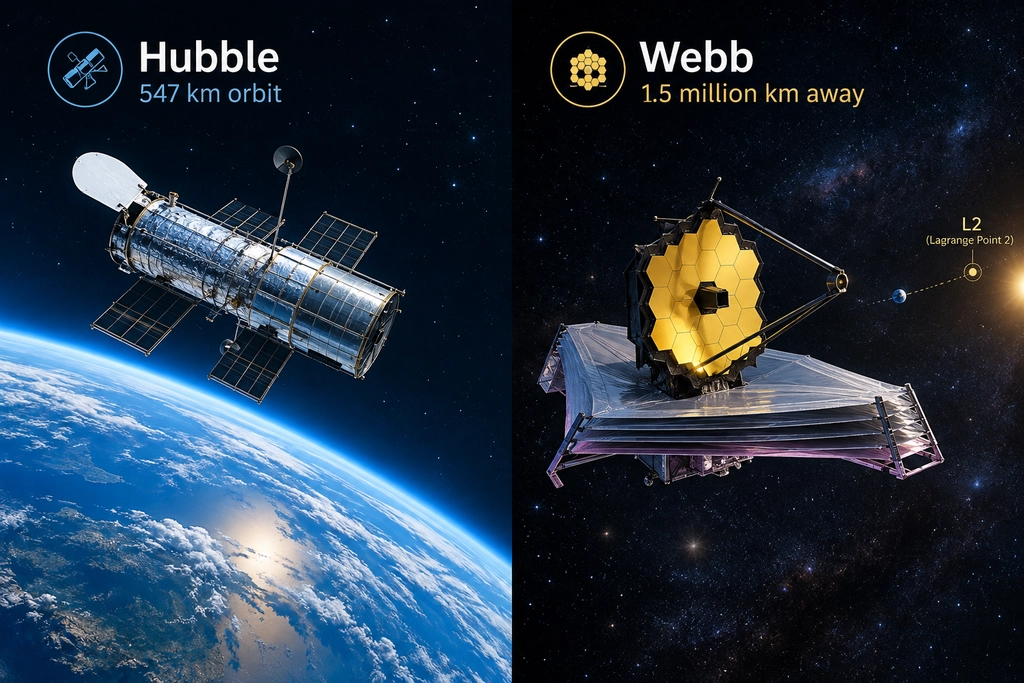
- → Webb orbits 1.5 million km from Earth at Lagrange Point 2 Hubble orbits Earth at just 547 km altitude, meaning it can be serviced by astronauts, while Webb sits too far away for any repair missions. [Canadian Space Agency]
- → The Pillars of Creation are 6,500 light-years from Earth Both Hubble and Webb have captured this famous star-forming region in the Eagle Nebula, with each telescope revealing different details based on its wavelength range. [Britannica]
Webb's mirror measures 6.5 meters across, built from 18 hexagonal segments, compared to Hubble's single 2.4-meter mirror, according to the Canadian Space Agency, 2026. That size gap changes how much light each telescope can gather and how far back in time it can look. Both machines still work today, and each one covers a job the other cannot do.
1How Do Hubble and Webb’s Specs Compare?
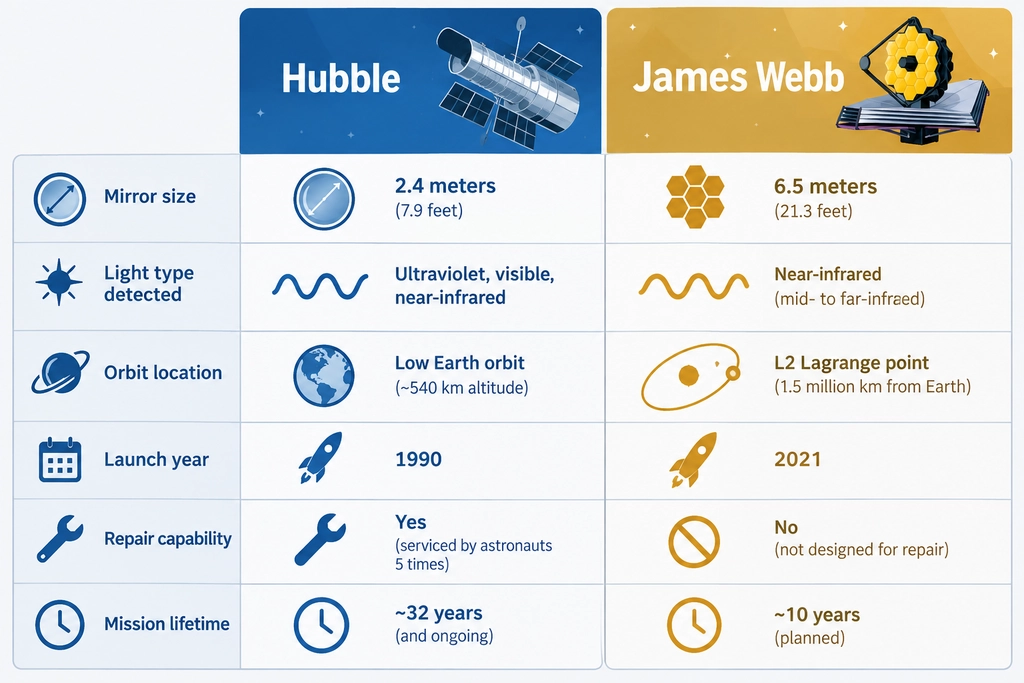
Webb's mirror is 6.5 meters wide versus Hubble's 2.4 meters. Hubble orbits Earth at 547 km, while Webb sits 1.5 million km away at Lagrange Point 2. Webb's mission is expected to last at least 5 years, possibly more than 10, per the Canadian Space Agency, 2026.
| METRIC | VALUE | SOURCE |
|---|---|---|
| Hubble mirror diameter | 2.4 meters | Britannica |
| Webb mirror diameter | 6.5 meters | Britannica |
| Hubble orbital altitude | 547 km | Canadian Space Agency |
| Webb distance from Earth | 1.5 million km | Canadian Space Agency |
| Pillars of Creation distance from Earth | 6500 light-years | ESA/Webb |
| Webb minimum mission lifetime | 5 years | Canadian Space Agency |
| Webb possible extended mission lifetime | 10+ years | Canadian Space Agency |
| Source: Britannica | ||
The distance gap explains a lot about what each telescope can do for scientists back on Earth. Hubble's low orbit at 547 km keeps it within reach of repair crews, a point covered in detail in the piece on the Hubble telescope's recent gyroscope issue. Webb's spot at Lagrange Point 2 keeps it cold and stable, which matters for infrared work, but it also means the telescope runs on a fixed fuel budget with no way to top it off. Anyone tracking other spacecraft with limited lifespans, such as the delays covered in the Boeing Starliner return timeline, will recognize the same tension between mission length and distance from Earth.
2What Has Changed Between Hubble’s Launch and Webb’s First Images?
Hubble launched in 1990 and had its mirror flaw fixed in 1993. Webb launched in 2021. Hubble's deep field reached galaxies 400 million years after the Big Bang, while Webb reaches galaxies from just 200 million years after it, per The Planetary Society, 2022.
| METRIC | VALUE | SOURCE |
|---|---|---|
| Hubble launch year | 1990 year | Canadian Space Agency |
| Webb launch year | 2021 year | Canadian Space Agency |
| Oldest galaxies seen by Hubble deep field, age after Big Bang | 400 million years | The Planetary Society |
| Oldest galaxies detectable by Webb, age after Big Bang | 200 million years | The Planetary Society |
| Hubble mirror repair year | 1993 year | Canadian Space Agency |
| Original Pillars of Creation Hubble image release year | 1995 year | ESA/Webb |
| Hubble Pillars of Creation revisit year | 2014 year | ESA/Webb |
| NASA SVS Pillars of Creation Hubble vs Webb release date | October 27, 2022 date | NASA SVS |
| Source: Canadian Space Agency | ||
Three decades separate these two launches, and the difference shows up directly in how far each telescope can see into the past. NASA's SVS released a side-by-side comparison of Hubble and Webb images of the Pillars of Creation on October 27, 2022, giving researchers a direct visual reference for the gap. Hubble first photographed the Pillars in 1995 and returned for another look in 2014, so the region has a documented history stretching across nearly two decades before Webb ever arrived. Readers who followed the launch buildup for other major space hardware, like the coverage of Europe's Ariane 6 rocket debut, will recognize how much planning goes into getting a telescope this size off the ground safely.
3Which Telescope Rates Higher on Key Capabilities?
Webb scores 10 out of 10 for mirror light-gathering size and 9 for dust penetration and deep field capability, according to Britannica, 2022 and ESA/Webb, 2022. Hubble scores 9 for serviceability, since astronauts can reach and repair it, unlike Webb.
| METRIC | VALUE | SOURCE |
|---|---|---|
| Light range detected | 3 rating | Canadian Space Agency |
| Deep field capability | 9 rating | The Planetary Society |
| Serviceability | 9 rating | Canadian Space Agency |
| Mirror light-gathering size | 10 rating | Britannica |
| Dust penetration | 9 rating | ESA/Webb |
| Source: Canadian Space Agency | ||
Webb's near-perfect marks for light-gathering and dust penetration come directly from its infrared design, which lets it see through gas clouds that block visible light entirely. Hubble's strong serviceability score reflects the reality that engineers on the ground can still send a repair crew if something breaks, something covered by the Canadian Space Agency's 2026 assessment. That kind of hands-on fix is not an option for spacecraft operating far from Earth, a challenge also seen in reporting on NOAA's satellite launch schedule. For missions like Webb, every rating tied to distance becomes a trade-off between capability and risk.
Complete Data Reference
Sortable table of all verified data points. Click any column header to sort.
| Metric | Value | Source | Year |
|---|---|---|---|
| Hubble mirror diameter | 2.4 meters | Britannica | 2022 |
| Webb mirror diameter | 6.5 meters | Britannica | 2022 |
| Hubble launch year | 1990 year | Canadian Space Agency | 2026 |
| Webb launch year | 2021 year | Canadian Space Agency | 2026 |
| Hubble orbital altitude | 547 km | Canadian Space Agency | 2026 |
| Webb distance from Earth | 1.5 million km | Canadian Space Agency | 2026 |
| Oldest galaxies seen by Hubble deep field, age after Big Bang | 400 million years | The Planetary Society | 2022 |
| Oldest galaxies detectable by Webb, age after Big Bang | 200 million years | The Planetary Society | 2022 |
| Pillars of Creation distance from Earth | 6500 light-years | ESA/Webb | 2022 |
| Hubble mirror repair year | 1993 year | Canadian Space Agency | 2026 |
| Webb minimum mission lifetime | 5 years | Canadian Space Agency | 2026 |
| Webb possible extended mission lifetime | 10+ years | Canadian Space Agency | 2026 |
| Original Pillars of Creation Hubble image release year | 1995 year | ESA/Webb | 2022 |
| Hubble Pillars of Creation revisit year | 2014 year | ESA/Webb | 2022 |
| NASA SVS Pillars of Creation Hubble vs Webb release date | October 27, 2022 date | NASA SVS | 2022 |
| Light range detected | 3 rating | Canadian Space Agency | 2026 |
| Deep field capability | 9 rating | The Planetary Society | 2022 |
| Serviceability | 9 rating | Canadian Space Agency | 2026 |
| Mirror light-gathering size | 10 rating | Britannica | 2022 |
| Dust penetration | 9 rating | ESA/Webb | 2022 |
Methodology
Some figures, such as galaxy age estimates and Pillars of Creation distance, come from 2022 sources and may be refined as new observations are published. Webb's mission lifetime remains an estimate tied to remaining propellant, which is not fixed. Data was gathered from six publicly available sources and not independently verified against raw mission telemetry.
- Sources consulted: 6
- Sources cited: 6
- Data range: 2022-2026
- Freshness: 3 current-year, 0 last-year, 3 older
- Update schedule: Quarterly
Frequently Asked Questions
What is the main difference between Hubble and James Webb?
Hubble mainly sees visible and ultraviolet light, while Webb sees mostly infrared light. Webb's mirror is 6.5 meters wide compared to Hubble's 2.4 meters, so it gathers far more light. This lets Webb spot fainter, older, and more distant objects that Hubble cannot detect. [Canadian Space Agency]
Is Webb's image quality better than Hubble's?
Not exactly sharper, just different. Webb delivers about the same resolution in near-infrared light as Hubble does in visible light, according to NASA Science. So Webb isn't simply a stronger version of Hubble; each telescope shows different details based on the type of light it captures. [NASA Science]
Which telescope can see further back in time?
Webb wins here. It can spot galaxies formed just 200 million years after the Big Bang, while Hubble's deep field images only reached galaxies from 400 million years after the Big Bang, per The Planetary Society. Webb's infrared vision picks up light stretched by the growth of space over billions of years. [The Planetary Society]
Where is each telescope located in space?
Hubble orbits Earth at just 547 km altitude, close enough for astronauts to reach and repair it. Webb sits about 1.5 million km away at a spot called Lagrange Point 2, far too distant for any repair mission, as noted by the Canadian Space Agency. [Canadian Space Agency]
Can astronauts fix James Webb like they fixed Hubble?
No. Astronauts corrected Hubble's mirror flaw in 1993 using the Canadarm during a servicing mission, but Webb orbits too far from Earth for any crewed repair trip. If something breaks on Webb, engineers must work around the problem from the ground instead. [Canadian Space Agency]
How long will James Webb keep working?
Webb's minimum expected lifetime is 5 years, but engineers hope it lasts beyond 10 years since its launch used less fuel than planned. Because there's no way to refuel it in deep space, its lifespan depends entirely on how long its propellant holds out. [Canadian Space Agency]
Did Hubble and Webb both photograph the Pillars of Creation?
Yes. This famous star-forming region in the Eagle Nebula, located 6,500 light-years from Earth, has been captured by both telescopes. Hubble's visible-light view shows dense dust clouds, while Webb's infrared view reveals newborn stars hidden inside the pillars, according to ESA/Webb. [ESA/Webb]
When did Hubble and Webb launch?
Hubble launched in 1990, giving it over three decades of observation time, while Webb launched in 2021. The two telescopes now work together, with Webb building on Hubble's discoveries rather than replacing it, according to the Canadian Space Agency. [Canadian Space Agency]
Why does Webb's mirror have hexagonal segments?
Webb's mirror is made of 18 hexagonal segments that fold up for launch and unfold in space, since a single 6.5-meter mirror would not fit inside a rocket. Hubble's 2.4-meter mirror is one solid piece, which was possible because it's much smaller, per Britannica. [Britannica]
Does Webb replace Hubble completely?
No. Hubble still operates and observes visible and ultraviolet light that Webb cannot see, so the two telescopes complement each other. Scientists often compare images from both, such as the Pillars of Creation, to get a fuller picture of the same object, as shown by NASA's SVS comparison tool. [NASA Science]
Sources & References
- NASA Science. "Hubble vs. Webb" — science.nasa.gov. Accessed 2026-09-18.
- The Planetary Society. "JWST versus Hubble: How are they different?" — planetary.org. Accessed 2026-09-18.
- Canadian Space Agency. "James Webb telescope vs Hubble" — asc-csa.gc.ca. Accessed 2026-09-18.
- ESA/Webb. "Hubble and Webb Showcase the Pillars of Creation (Slider Tool)" — esawebb.org. Accessed 2026-09-18.
- Britannica. "Comparison of the James Webb and Hubble space telescopes" — britannica.com. Accessed 2026-09-18.
- NASA SVS. "Pillars of Creation: Hubble vs Webb" — svs.gsfc.nasa.gov. Accessed 2026-09-18.
Last updated: September 19, 2026