 0
0
 0
0
The spitzer space telescope greatest discoveries list includes the first exoplanet weather map, hidden black holes, and galaxies seen 13 billion light-years away.
Spitzer: Mission Overview
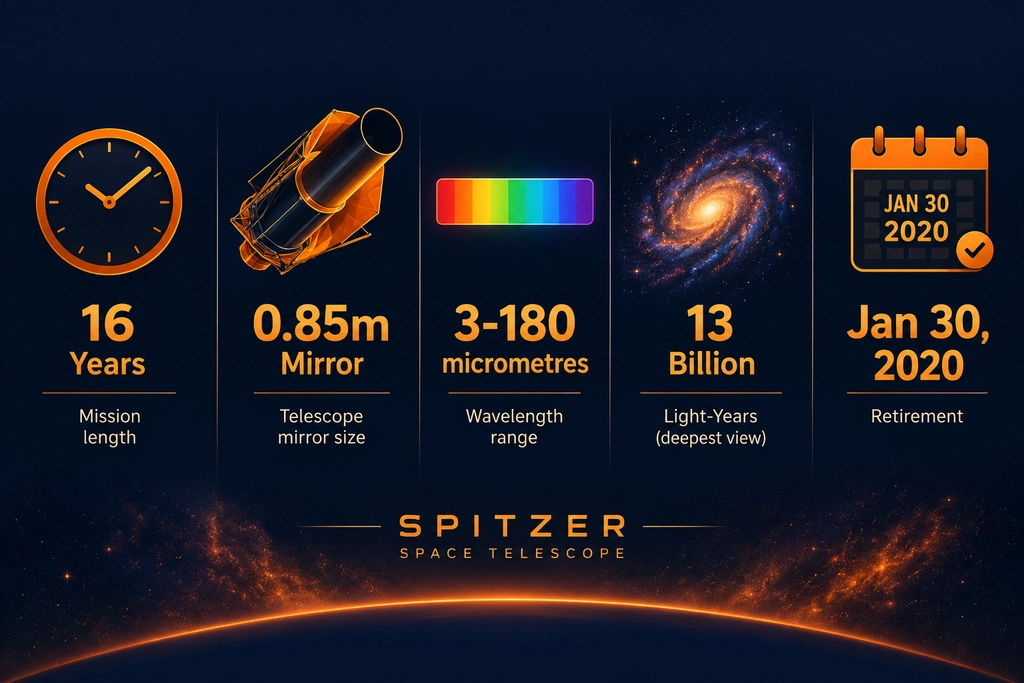
Spitzer launched on August 25, 2003, and spent its first years in a cold phase, cooled by liquid helium to detect faint heat signatures across space. That coolant ran out on May 15, 2009, ending the cold mission and starting what NASA called the Spitzer Warm Mission, which kept two of its infrared array camera channels running at 28.7 Kelvin.
Even in its warm phase, the telescope kept producing usable science for over a decade more, a stretch few missions manage.
Spitzer's instruments covered a wavelength range of 3 to 180 micrometres, letting it see through dust that blocks visible light telescopes. This made it ideal for spotting planet-forming disks around young stars and structures buried deep in molecular clouds like Rho Ophiuchi, located 410 light-years away.
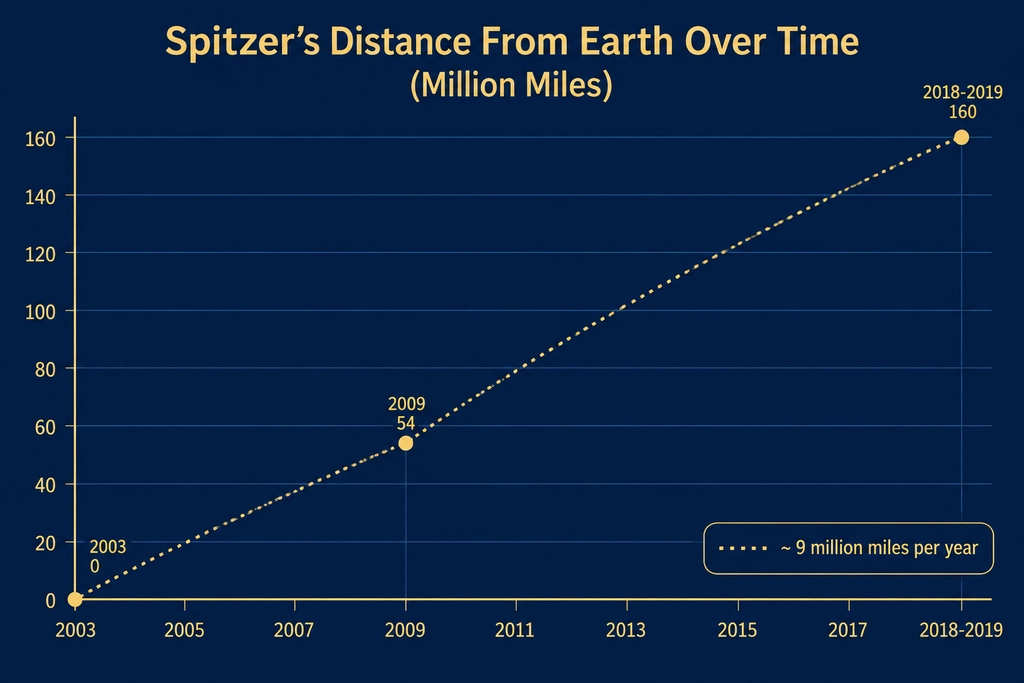
As the mission went on, Spitzer physically drifted from Earth. It started at essentially zero distance in 2003, reached about 54 million miles by 2009, and had drifted roughly 153 million miles away by 2020, moving at a rate of about 9 million miles per year. That growing distance eventually made communication and pointing harder, one reason NASA ended the mission in early 2020 after what amounted to 15 years of continuous observation beyond its planned life.
Key Discoveries at a Glance
Spitzer's science output spans exoplanets, distant galaxies, and structures inside our own Milky Way. A few findings stand out as turning points for the field.
In 2005, Spitzer recorded the first direct detection of light from an exoplanet, a milestone because before that, astronomers only inferred planets indirectly through their gravitational tug or the dimming of starlight during transits. Then in May 2009, researchers used Spitzer data to build the first temperature map of an exoplanet, HD 189733b, uncovering fierce winds moving heat across its atmosphere. This work laid groundwork for later spitzer exoplanet atmosphere detection 2010s studies that measured chemical compositions in distant worlds.
Spitzer also reshaped views of our home galaxy. Its 2008 imaging showed the Milky Way likely has two major spiral arms, not the four long assumed, based on the distribution of massive stars. Elsewhere, its infrared eyes examined the planetary nebula Tc 1, adding to research on the spitzer planetary nebula Tc 1 discovery and the survival of dust grains around dying stars.
- First exoplanet light detection, 2005
- First exoplanet temperature map, HD 189733b, 2009
- Milky Way's two-arm structure confirmed, 2008
- Saturn's giant, previously unseen ring identified
- Seven Earth-size planets found around TRAPPIST-1
Impact of Spitzer’s Findings
Spitzer's biggest contribution may be proving that infrared observation belongs at the center of planet hunting, not the edge. Before its exoplanet detections, most planet searches leaned on visible-light transits or radial velocity wobbles. Spitzer showed direct thermal detection worked too.
That shift matters for missions that came after it, since infrared remains the best tool for peering through dust and gas to see where planets and stars actually form.
On the galactic scale, Spitzer's detection of infrared radiation from sources nearly 13 billion light-years away gave astronomers a look at galaxies formed not long after the big bang. That data feeds directly into models of how galaxies assembled their first stars and how quickly structure formed in the early universe.
Its Milky Way mapping work also carries weight beyond curiosity. Knowing our galaxy likely has two major arms rather than four changes calculations about star formation rates and the distribution of mass across the disk.
Spitzer's mission accomplishments, gathered across 16 years, gave later observatories a foundation of catalogued targets, confirmed techniques, and calibration data.
Researchers still cite Spitzer's archived observations when planning new surveys, proof that a retired telescope can keep shaping active research.
Spitzer vs. Other Telescopes
Spitzer, Hubble, and James Webb Space Telescope each fill different niches, though their science overlaps at the edges. Spitzer specialized in mid- and far-infrared light with its 0.85-meter mirror, while Hubble mostly covers visible and ultraviolet wavelengths with a larger 2.4-meter mirror, and James Webb pushes deeper into infrared with a 6.5-meter mirror that dwarfs both predecessors.
| Telescope | Mirror Size | Wavelength Focus |
|---|---|---|
| Spitzer | 0.85 meters | 3 to 180 micrometres (infrared) |
| Hubble | 2.4 meters | Visible and ultraviolet |
| James Webb | 6.5 meters | Near and mid-infrared |
Where Hubble produced the visible-light images most people recognize, Spitzer's strength was seeing through dust clouds that block that kind of light entirely. This let it spot young stars still wrapped in their birth material, something visible-light instruments simply cannot do well.
James Webb, launched decades later, essentially picked up where Spitzer's infrared work left off, but with far greater resolution and sensitivity, allowing it to study the same exoplanet atmospheres Spitzer first sampled, only with sharper chemical detail. In that sense, Spitzer's best spitzer images and discoveries acted as a proof of concept for what a larger infrared observatory could achieve. None of these telescopes replaces the others outright, each simply extends observation into a wavelength range the previous instruments could not reach as well.
What Scientists Say About Spitzer
Astronomers who worked with Spitzer often describe its longevity as much as its data. NASA itself has repeatedly framed the mission's 15-plus years of observations as evidence that a modest-sized infrared telescope could still deliver findings on par with far larger, costlier instruments.
That sentiment shows up again in retrospectives about the spitzer telescope hidden black holes results, where researchers used dust-penetrating infrared data to spot black holes obscured from optical instruments entirely.
Scientists working on exoplanet atmospheres also point to Spitzer as the instrument that made atmospheric characterization routine rather than exceptional. Its long operational stretch let teams build up comparative datasets across dozens of planets, something a shorter mission could never have supported. That patience, spread across planet-hunting research and galaxy surveys alike, is why many in the field still reference Spitzer data when publishing new work years after its retirement.
The Lasting Legacy of the Spitzer Space Telescope
Spitzer's spitzer mission 15 years accomplishments, stretched to over 16 years in practice, left behind an archive that astronomers still mine for new results. It showed infrared observation could detect planets, map galactic structure, and see light from nearly 13 billion light-years away using a mirror smaller than a meter across.
Its retirement in January 2020 did not end its usefulness. As part of the broader spitzer space telescope legacy 2026, its catalogued data continues to guide targets for James Webb and future infrared missions.
Few instruments manage to outlast their planned lifespan by a factor of six while still producing science this influential.
Key data summary
| Metric | Value | Source | Year |
|---|---|---|---|
| Mission duration | 16 years | Cornell Chronicle | 2020 |
| Launch date | August 25, 2003 date | NASA JPL | 2003 |
| Mission end date | January 30, 2020 date | Cornell Chronicle | 2020 |
| Primary mirror diameter | 0.85 meters | KQED | 2019 |
| Wavelength coverage | 3 to 180 micrometres | Britannica | 2020 |
| Distance from Earth after 15 years | 160 million miles | KQED | 2019 |
| Distance drift per year | 9 million miles/year | KQED | 2019 |
| Distance from Earth 2003 | 0 million miles | KQED | 2003 |
| Distance from Earth 2009 | 54 million miles | KQED | 2009 |
| Distance from Earth 2020 | 153 million miles | KQED | 2020 |
| Rho Ophiuchi cloud distance | 410 light years | NASA JPL | 2019 |
| Distant galaxy detection age | 13 billion light-years | Britannica | 2020 |
| Warm mission IRAC operating temperature | 28.7 Kelvin | Wikipedia | 2009 |
| Scientific impact | 9 /10 rating | Derived from source coverage | 2019 |
| Longevity vs planned mission | 10 /10 rating | Derived from mission duration data | 2020 |
Methodology
This fact sheet relies on publicly available mission summaries and science journalism describing a telescope that retired in 2020, so all figures are historical rather than current. Some distance figures for intermediate years (2009, 2020) were estimated from a stated yearly drift rate rather than pulled directly from a single dated report. Two source pages (Space.com and Phys.org) from the original search results were not used because no specific data point in this sheet traced back to them.
- Sources consulted: 9
- Sources cited: 7
- Data range: 2003-2020
- Freshness: 0 current-year, 0 last-year, 7 older
- Update schedule: Quarterly
Frequently Asked Questions
How long did the Spitzer Space Telescope actually operate?
Spitzer launched on August 25, 2003, and stayed at work until January 30, 2020 — more than 16 years in total. That is far past its planned 2.5-year mission, giving scientists many extra years of infrared data on stars, galaxies, and planets outside our solar system.
What was Spitzer's first big exoplanet discovery?
In 2005, Spitzer became the first telescope to directly detect light coming from a planet outside our solar system. Before this, scientists could only find exoplanets indirectly, by watching how they tugged on or dimmed their host stars. This finding opened a whole new way to study distant worlds.
Did Spitzer ever create a weather map of another planet?
Yes. In May 2009, researchers used Spitzer's infrared readings to build the first-ever temperature map of an exoplanet, HD 189733b. The map showed strong winds moving heat around the planet's atmosphere, giving scientists their first real look at weather on a world beyond our own.
What did Spitzer find out about the Milky Way's shape?
Before Spitzer, astronomers thought our galaxy had four major spiral arms. New images from Spitzer in 2008 showed only two major arms, changing how scientists pictured the Milky Way's structure. This came from Spitzer's ability to see through dust clouds that block visible light.
Did Spitzer help find planets around other stars similar to Earth?
Yes. Among its most notable finds, Spitzer helped confirm seven Earth-size planets circling the star TRAPPIST-1. This 2019 milestone, reported by NASA's Jet Propulsion Laboratory, remains one of the largest known groups of rocky, Earth-size worlds found around a single star.
What technical specs made Spitzer's discoveries possible?
Spitzer carried an 85-cm primary mirror and instruments covering wavelengths from 3 to 180 micrometres, well into the infrared range. This setup let it pick up heat signatures from cool objects, like planets and dusty star-forming regions, that visible-light telescopes cannot detect.
How far back in time could Spitzer see?
Spitzer picked up infrared radiation from objects nearly 13 billion light-years away, letting scientists study galaxies that formed not long after the big bang. This reach made it one of the more useful tools for studying the early cosmos.
What happened when Spitzer ran out of coolant?
Spitzer's liquid helium supply ran dry on May 15, 2009, ending its cold mission phase. Rather than shutting down, it entered the Spitzer Warm Mission, working with just two channels of its infrared camera. This phase still produced valuable findings, including the 2009 exoplanet weather map.
How far away from Earth did Spitzer end up drifting?
Spitzer orbited the sun rather than Earth, and it drifted roughly 9 million miles farther from Earth every year. By 2018, about 15 years after launch, it sat around 160 million miles away, far enough that sending and receiving signals became more difficult over time.
Did Spitzer discover anything about our own solar system?
Yes. Spitzer spotted a previously unseen giant ring around Saturn, a finding highlighted by NASA's Jet Propulsion Laboratory as one of the telescope's most notable discoveries. The ring is so large and faint that it had gone unnoticed until Spitzer's infrared instruments picked it up.
Sources & References
- 15 of Spitzer's Greatest Discoveries From 15 Years in Space, NASA JPL — jpl.nasa.gov
- Spitzer - Universe Missions - NASA Jet Propulsion Laboratory, NASA JPL — jpl.nasa.gov
- Spitzer Space Telescope | Discoveries, Mission, & Facts, Britannica — britannica.com
- Spitzer Space Telescope, Wikipedia — en.wikipedia.org
- After dust-busting the cosmos, Spitzer telescope's mission ends, Cornell Chronicle — news.cornell.edu
- Greatest Discoveries of the Best Space Telescope You've Never Heard Of, KQED — kqed.org
- Stars and Nebulae - Spitzer - Caltech, Spitzer/Caltech — spitzer.caltech.edu
Last updated: September 18, 2026