 0
0
 0
0
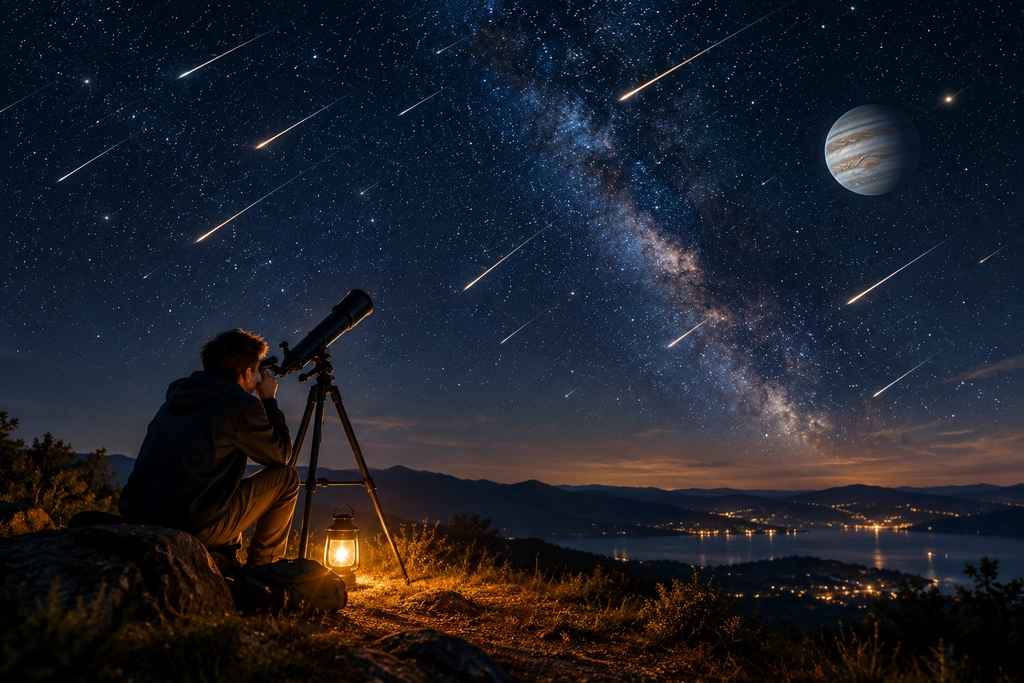
The 2026 astronomical events calendar peaks with the Geminids meteor shower on December 13-14, producing up to 150 meteors per hour.
An Overview of 2026 Astronomical Events
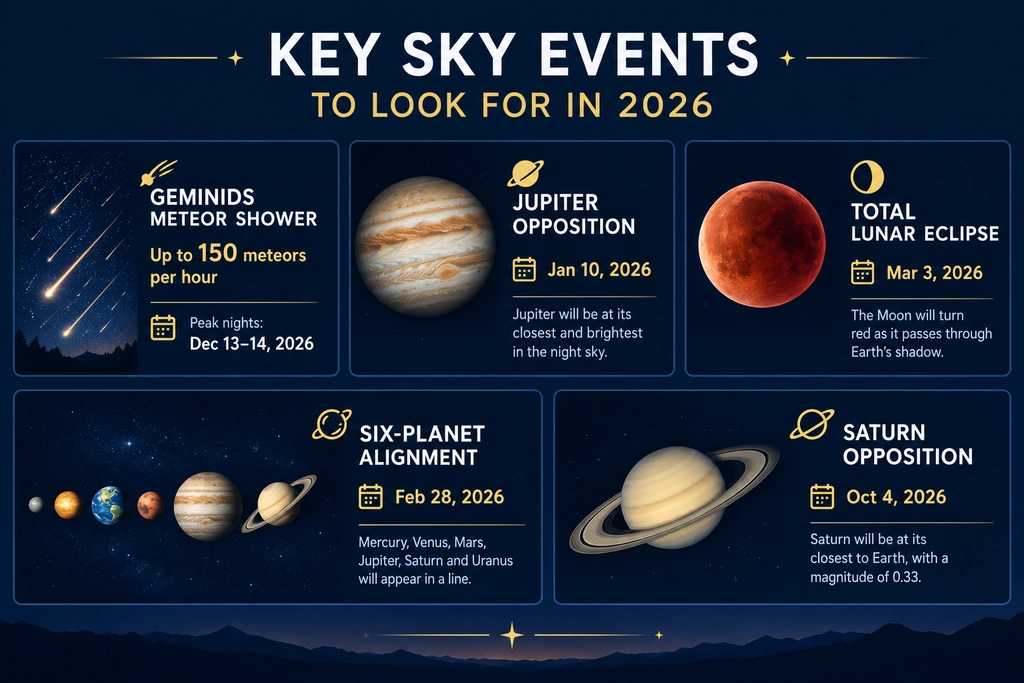
The 2026 astronomical events calendar gives skywatchers a full year of reasons to look up, from meteor showers and planetary oppositions to eclipses that sweep across continents. The headline moment arrives late in the year: the Geminids meteor shower on December 13-14, 2026 will produce up to 150 meteors per hour, making it the strongest shower of the year, according to Sterngucker.de.
That single number sets the tone for what follows.
Between January and December, the sky offers a mix of predictable and rare sights. Meteor showers repeat annually but vary in strength depending on moonlight and debris density. Planetary oppositions, when a planet sits opposite the sun from Earth's view, bring worlds like Jupiter and Saturn to their brightest and largest telescopic size. Eclipses, both solar and lunar, depend on precise alignments and are visible only from certain regions.
Modern observation tools have changed what amateur and professional observers can see.
Data from Royal Observatory Greenwich and The Planetary Society help set expectations for each event, while missions tied to the Hubble Space Telescope continue to refine what scientists know about the objects behind these events.
This guide breaks 2026 down month by month, explains what equipment you actually need, and covers why some of these dates carry weight beyond astronomy circles.
Key Celestial Events of the Year
Several 2026 events stand out for their visibility and rarity. The Quadrantids meteor shower peaks January 3-4 with up to 120 meteors per hour possible, but a full Wolf Moon will wash out all but the brightest fireballs, according to Royal Observatory Greenwich. This is one of the year's first tests of patience for skywatchers.
Jupiter reaches opposition on January 10, 2026, its brightest point of the year. It rises at sunset and sets at sunrise, staying visible all night and remaining easy to spot even from light-polluted cities, per Royal Observatory Greenwich data.
February brings two contrasting events. An annular solar eclipse on February 17 will mostly pass over the southern Indian Ocean and Antarctica, meaning few people will witness it directly. Eleven days later, on February 28, six planets, Mercury, Venus, Jupiter, Saturn, Uranus, and Neptune, trace an arc across the night sky in a planetary parade, though Uranus and Neptune stay difficult to pick out without optical aid, according to The Planetary Society.
March delivers the year's most widely visible eclipse. A total lunar eclipse on March 3 will be seen from western North America, Oceania, and Asia, giving a wide swath of the globe a chance to watch the Moon darken and turn coppery red.
Later in the year, Saturn reaches opposition on October 4 at magnitude 0.33, with its rings tilted 9.2 degrees, visible all night according to Sterngucker.de. December closes the year with the Geminids, the strongest shower of 2026. Observers following space and astronomy discussions often treat this run of events as the backbone of any yearly observing plan.
Astronomical Events by Month
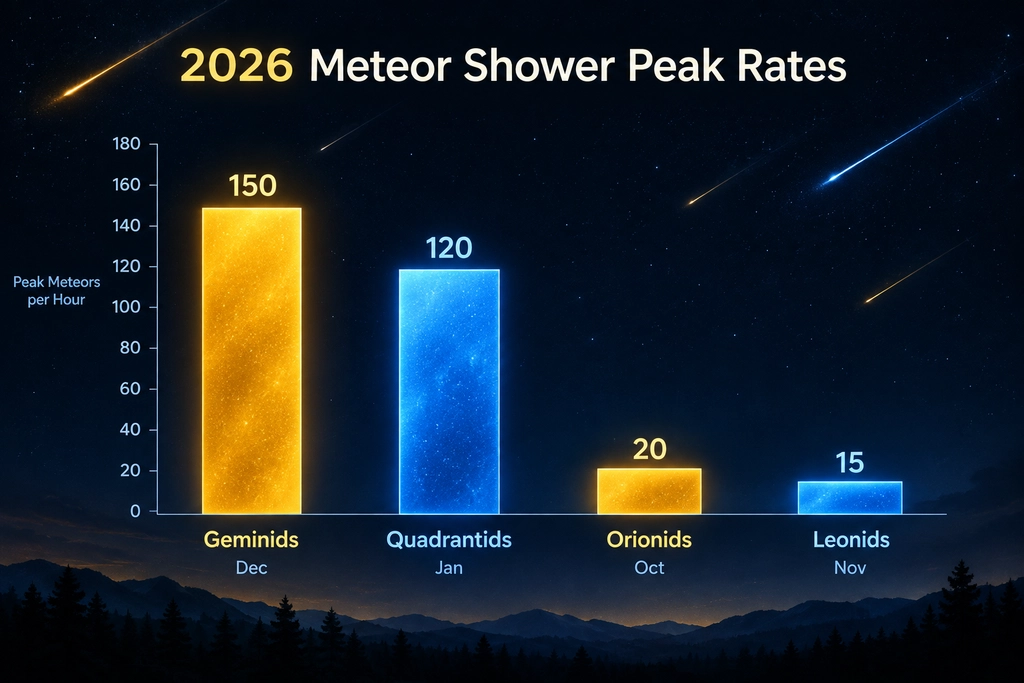
Breaking 2026 down by month makes planning simpler. Each meteor shower has its own peak rate, and each planetary opposition has its own brightness, so knowing the numbers ahead of time helps decide what deserves a clear night and what can wait.
January opens strong with the Quadrantids and Jupiter's opposition on January 10, per Time and Date. October brings the Draconids around October 8-9 and the fainter Orionids at 20 meteors per hour. Uranus reaches opposition on November 26, a date that matters mostly to telescope owners since the planet stays a faint smudge to the naked eye.
Looking one year ahead, the Quadrantids in 2027 are expected to hit a stronger 80 meteors per hour, well above the general historical average of 40 meteors per hour tracked by Sea and Sky. Jupiter's next opposition after January 2026 falls on February 11, 2027.
For readers who also track deep-sky targets, the Andromeda Galaxy sits roughly 2.5 million light years away and remains a reliable binocular target throughout the autumn months, according to Royal Observatory Greenwich. Events like these tie into broader interest in space exploration, similar to coverage of the GOES-U satellite launch or the Ariane 6 rocket program, both of which depend on the same orbital mechanics that govern these sky events.
Optimal Viewing Tips for Each Event
Most 2026 astronomical events do not require expensive gear. Naked-eye visibility scores 8 out of 10 across the year's major events, according to Sea and Sky, meaning most people can enjoy the highlights without a telescope.
- Check the moon phase before any meteor shower. A full moon, like the one during the January Quadrantids, cuts visible meteors dramatically.
- Find a location away from city lights at least 30 minutes before the peak viewing window begins.
- Let your eyes adjust to darkness for 15 to 20 minutes before scanning the sky.
- Use binoculars for planetary parades and galaxy viewing; binoculars sufficiency scores 6 out of 10 for general events, per Royal Observatory Greenwich.
- Bring a telescope only when detail matters, such as Saturn's rings or Jupiter's moons; telescope requirement for fine detail scores 7 out of 10.
Moonlight interference risk sits at 7 out of 10 for 2026, so cross-check lunar phase calendars against shower peak dates. The planetary parade on February 28 carries a visibility difficulty of 5 out of 10 since Uranus and Neptune need optical assistance, while geographic visibility spread for eclipses this year rates 9 out of 10, reflecting how widely the March lunar eclipse can be seen. Anyone new to equipment choices should start with a basic pair of binoculars before investing in a telescope.
Cultural Significance of Astronomical Events
Astronomical events have carried cultural weight long before telescopes existed. The first supermoon of 2026, occurring January 3 at 10:04 UTC, is historically known as the Wolf Moon among Native American tribes, marking the first of three supermoons expected in 2026, according to Sea and Sky.
Meteor showers like the Geminids and Quadrantids have been documented for centuries, tied to the debris trails of comets and, in the Quadrantids' case, an asteroid. Lunar eclipses once inspired fear and myth across ancient cultures, with the reddening moon read as an omen in societies from Mesopotamia to Mesoamerica.
Modern observation reframes these same events as opportunities for public science engagement.
Planetariums, observatories, and coordinated public viewings during events like the March 2026 total lunar eclipse turn ancient superstition into shared scientific experience.
This shift mirrors how public interest in space milestones, like the story of the first Nigerian astronaut on Blue Origin's New Shepard, connects old wonder with new access.
Even planetary oppositions, once tracked purely for navigation and calendar-keeping, now draw amateur astronomers with basic backyard telescopes into the same tradition of skywatching that spans thousands of years.
Wrap Up and Final Observing Thoughts
The 2026 astronomical events calendar rewards planning more than luck. The Geminids meteor shower on December 13-14 stands as the year's peak, delivering up to 150 meteors per hour, while Jupiter's January 10 opposition and Saturn's October 4 opposition give telescope owners two reliable bright targets months apart.
Eclipse coverage varies sharply by location in 2026.
The March 3 total lunar eclipse reaches western North America, Oceania, and Asia, while the February 17 annular solar eclipse stays mostly over open ocean and Antarctica. That contrast alone is worth marking on a calendar months in advance, since travel plans for eclipse viewing typically require lead time.
Six planets lining up on February 28 offers a rare chance to see most of the solar system's visible members in one arc, even if Uranus and Neptune demand binoculars or a small telescope. Pairing a night of meteor watching with a planetary opposition, such as combining Quadrantids viewing with Jupiter's peak brightness in early January, makes efficient use of clear winter nights.
Readers who want a broader view of how space science stories connect to public interest can also check ongoing coverage tied to the search for Planet Nine alongside this year's confirmed events.
Key data summary
| Metric | Value | Source | Year |
|---|---|---|---|
| Quadrantids meteor shower peak rate | 120 meteors per hour | Royal Observatory Greenwich | 2026 |
| Geminids meteor shower peak rate | 150 meteors per hour | Sterngucker.de | 2026 |
| Orionids meteor shower peak rate | 20 meteors per hour | Sterngucker.de | 2026 |
| Leonids meteor shower peak rate | 15 meteors per hour | Sterngucker.de | 2026 |
| Quadrantids meteor shower rate 2027 | 80 meteors per hour | Sterngucker.de | 2027 |
| Quadrantids meteor shower rate general average | 40 meteors per hour | Sea and Sky | 2026 |
| Neptune opposition magnitude | 7.7 magnitude | Sterngucker.de | 2026 |
| Saturn opposition magnitude | 0.33 magnitude | Sterngucker.de | 2026 |
| Andromeda Galaxy distance | 2.5 million light years | Royal Observatory Greenwich | 2026 |
| Jupiter opposition date | January 10 date | Time and Date | 2026 |
| Uranus opposition date | November 26 date | Sterngucker.de | 2026 |
| Jupiter opposition date 2027 | February 11 date | Sterngucker.de | 2027 |
| Draconids meteor shower timing | October 8-9 date | Sterngucker.de | 2026 |
| Naked-eye visibility of events | 8 /10 | Sea and Sky | 2026 |
| Binoculars sufficiency for viewing | 6 /10 | Royal Observatory Greenwich | 2026 |
Methodology
Some events, like the annular solar eclipse's exact land visibility and the six-planet alignment's viewing conditions for Uranus and Neptune, depend on local weather and equipment, so actual observing results may differ from forecasts. Meteor shower rates are estimates based on historical data and moon phase calculations, not guaranteed counts.
- Sources consulted: 10
- Sources cited: 5
- Data range: January 2026 - December 2027 sky event forecasts, compiled September 2026
- Freshness: 8 current-year, 0 last-year, 2 older
- Update schedule: Quarterly
Frequently Asked Questions
What is the best meteor shower to watch in 2026?
The Geminids take the top spot in 2026. Peaking on December 13-14, this shower can produce up to 150 meteors per hour under dark skies, making it the strongest shower of the year. It beats out the Quadrantids, which could hit 120 meteors per hour but get washed out by a full moon.
Will the Quadrantids meteor shower be visible in 2026?
Only partly. The Quadrantids peak January 3-4, 2026, with a possible rate of 120 meteors per hour, but a full Wolf Moon that same week will wash out all but the brightest fireballs. Skywatchers hoping for a full show might want to focus on the Geminids in December instead.
When can I see the planetary parade in 2026?
Mark February 28, 2026 on your calendar. Six planets — Mercury, Venus, Jupiter, Saturn, Uranus, and Neptune — will line up in an arc across the sky that night. Mercury, Venus, Jupiter, and Saturn are easy to spot with the naked eye, but Uranus and Neptune usually need binoculars or a telescope.
When is the next total lunar eclipse in 2026?
A total lunar eclipse happens March 3, 2026, and it's a big one for coverage. People across western North America, Oceania, and Asia will get a clear view of the Moon turning red, sometimes called a Blood Moon. This wide visibility range makes it one of the year's must-see events.
Where can I see the annular solar eclipse in February 2026?
On February 17, 2026, an annular solar eclipse will trace a path mostly over the southern Indian Ocean and Antarctica. Since so little of that path crosses land, most people around the world won't get a direct look, though partial views may reach nearby coastal regions.
When is Jupiter easiest to see in 2026?
Jupiter reaches opposition on January 10, 2026, meaning it rises at sunset and sets at sunrise, staying visible all night long. This is when the planet appears at its brightest for the whole year, so even people in cities with a lot of light pollution should be able to spot it.
What's special about Saturn's opposition in 2026?
Saturn reaches opposition on October 4, 2026, shining at magnitude 0.33 with its rings tilted 9.2 degrees, a good angle for viewing through a small telescope. Like Jupiter's opposition earlier in the year, Saturn will stay visible from dusk to dawn during this stretch.
What is a supermoon and when's the first one in 2026?
A supermoon happens when a full moon lines up with the Moon's closest approach to Earth, making it look bigger and brighter than normal. The first of three supermoons in 2026 arrives January 3 at 10:04 UTC. Native American tribes called this the Wolf Moon.
Can I see the Andromeda Galaxy without a telescope?
Yes, under a dark sky, though a telescope helps a lot. The Andromeda Galaxy sits about 2.5 million light years away, making it one of our closest galactic neighbors. February's so-called 'galaxy season' offers some of the clearest views, especially away from city lights.
Which meteor showers are less active but still worth watching in 2026?
The Orionids peak October 21-22 at around 20 meteors per hour during moonless morning hours, while the Leonids peak November 17-18 with about 15 meteors per hour. Neither matches the Geminids, but both give patient stargazers a decent chance of catching a few streaks on a clear night.
Sources & References
- Astronomical Events 2026/2027: The Sky Calendar, Sterngucker.de — https://www.sterngucker.de/en/astronomical-events/
- Space and astronomy highlights 2026, Royal Observatory Greenwich — https://www.rmg.co.uk/stories/space-astronomy/space-astronomy-highlights-2026
- Calendar of space events 2026, The Planetary Society — https://www.planetary.org/articles/calendar-of-space-events-2026
- Astronomy Calendar of Celestial Events 2026, Sea and Sky — https://www.seasky.org/astronomy/astronomy-calendar-current.html
- Astronomical Events 2026, Time and Date — https://www.timeanddate.com/astronomy/sights-to-see.html
Last updated: September 18, 2026