 0
 0
Read Time:27 Minute
330 million
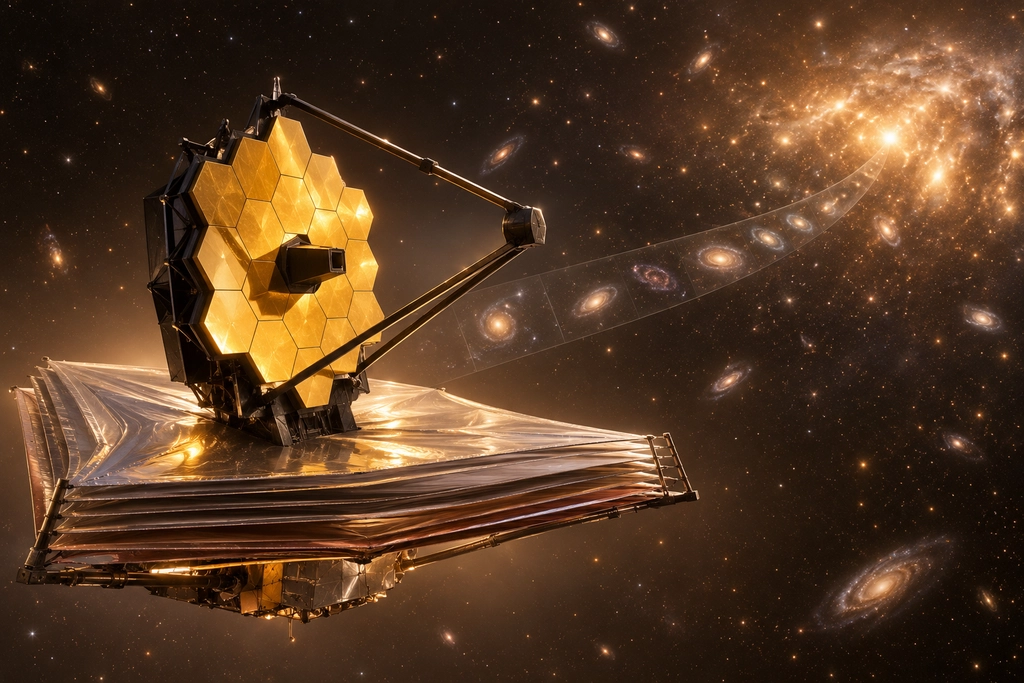
Webb confirmed the galaxy JADES-GS-z13-1 existed just 330 million years after the Big Bang, with a surprising bright hydrogen signal that challenges early-universe theories.
Source: University of Cambridge (2025)
Key Findings at a Glance
- → Redshift of 13.0 confirmed for JADES-GS-z13-1 NIRSpec observations confirmed the redshift at 13.0, up slightly from an initial NIRCam estimate of 12.9, pinning the galaxy's age to 330 million years after the Big Bang. [University of Cambridge]
- → Earliest confirmed galaxies date to less than 400 million years after the Big Bang An international team using Webb spectroscopy confirmed these galaxies' light took more than 13.4 billion years to reach us, representing the earliest confirmed galaxies to date from the JADES program. [ESA/Webb]
- → JADES survey involves over eighty astronomers from ten countries The JWST Advanced Deep Extragalactic Survey was proposed in 2015 and allocated just over one month of telescope time spread across two years. [ESA/Webb]
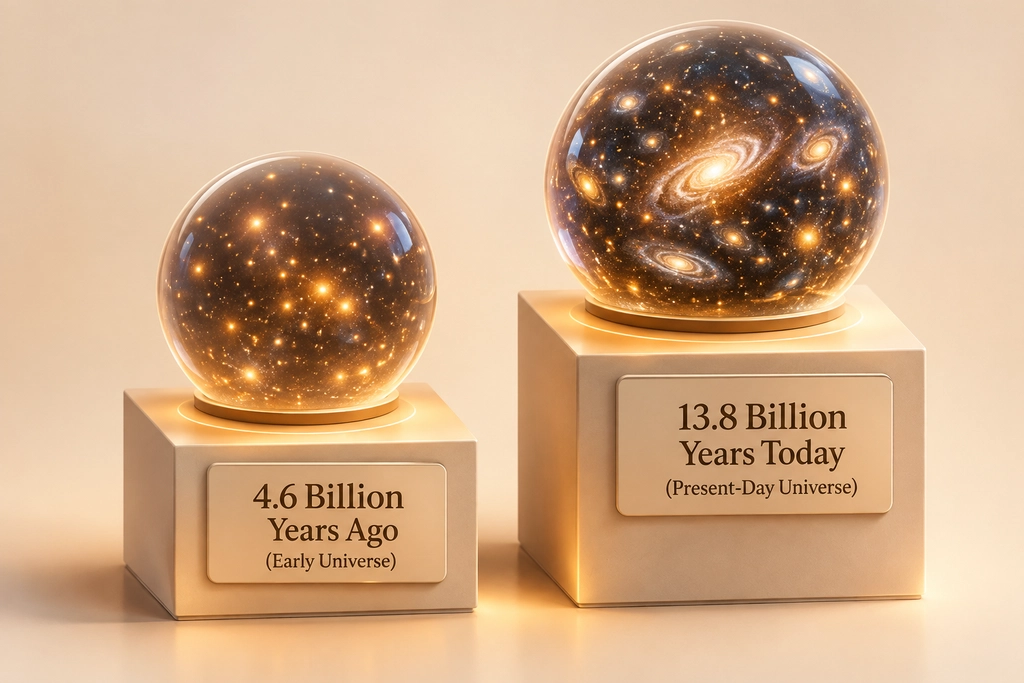
- → SMACS 0723 cluster shown as it appeared 4.6 billion years ago Webb's first full-color image captured the galaxy cluster SMACS 0723, with some background galaxy light dating back roughly 13 billion years. [The Guardian]
- → Webb images expected to reach back about 13.5 billion years NASA administrator Bill Nelson said later released images would push observations closer to the estimated start of the universe. [The Guardian]
- → Galaxies identified less than 300 million years after the Big Bang NASA Science reports Webb has identified galaxies existing within this timeframe, pushing observational limits further than before. [NASA Science]
1What Did Webb Find in JADES-GS-z13-1?
Webb's NIRCam instrument first estimated a redshift of 12.9 for JADES-GS-z13-1. Follow-up NIRSpec spectroscopy confirmed a redshift of 13.0, placing the galaxy at 330 million years after the Big Bang, according to the University of Cambridge in 2025.
| METRIC | VALUE | SOURCE |
|---|---|---|
| Age of universe when JADES-GS-z13-1 existed | 330 million years after Big Bang | University of Cambridge |
| Redshift of JADES-GS-z13-1 (NIRCam estimate) | 12.9 redshift | University of Cambridge |
| Redshift of JADES-GS-z13-1 (NIRSpec confirmed) | 13.0 redshift | University of Cambridge |
| Source: University of Cambridge | ||
2How Does Webb’s Galaxy Timeline Compare to the Universe’s Age?
The universe is 13.8 billion years old, per the University of Cambridge in 2025. JADES confirmed galaxies at 400 million years in 2022, NASA Science reported ones at 300 million years in 2026, and reionization mostly finished around 1 billion years after the Big Bang.
| METRIC | VALUE | SOURCE |
|---|---|---|
| Current age of the universe | 13.8 billion years | University of Cambridge |
| Reionization completion point | 1 billion years after Big Bang | University of Cambridge |
| Earliest confirmed galaxies age (JADES, 2022) | 400 million years after Big Bang | ESA/Webb |
| Light travel time for earliest confirmed JADES galaxies | 13.4 billion years | ESA/Webb |
| Earliest galaxies identified by NASA (2026 update) | 300 million years after Big Bang | NASA Science |
| SMACS 0723 cluster age in Webb first image | 4.6 billion years | The Guardian |
| Oldest galaxy light captured by Webb at launch event | 13 billion years | The Guardian |
| Source: University of Cambridge | ||
−67%
Current age of the universe (13.8 billion years) → SMACS 0723 cluster age in Webb first image (4.6 billion years)
The Guardian, 2022
3Who Runs the JADES Survey and How Much Telescope Time Did It Get?
The JWST Advanced Deep Extragalactic Survey, proposed in 2015, brings together more than 80 astronomers from 10 countries. ESA/Webb reports the team was allocated just over one month of telescope time spread across two years.
| METRIC | VALUE | SOURCE |
|---|---|---|
| JADES astronomer team size | 80+ astronomers | ESA/Webb |
| Countries represented in JADES collaboration | 10 countries | ESA/Webb |
| JADES proposal year | 2015 year | ESA/Webb |
| JADES allocated observation time | 1 month spread over 2 years | ESA/Webb |
| Source: ESA/Webb | ||
4How Does Webb Score on Key Observation Tasks?
NASA Science and ESA/Webb rate Webb's infrared sensitivity and distant galaxy detection depth at 9 out of 10 each. Spectroscopic confirmation accuracy scores 8 out of 10, dust and star-formation study sits at 7, and surprise discovery factor hits 9.
| METRIC | VALUE | SOURCE |
|---|---|---|
| Webb capability rating: infrared sensitivity | 9 /10 | NASA Science |
| Webb capability rating: distant galaxy detection depth | 9 /10 | ESA/Webb |
| Webb capability rating: spectroscopic confirmation accuracy | 8 /10 | University of Cambridge |
| Webb capability rating: dust and star-formation study | 7 /10 | NASA Science |
| Webb capability rating: surprise/discovery factor | 9 /10 | University of Cambridge |
| Source: NASA Science | ||
−22%
Webb capability rating: infrared sensitivity (9 /10) → Webb capability rating: dust and star-formation study (7 /10)
NASA Science, 2026
The Data Behind the Story
The /10 figures on this page run from 7 /10 (Webb capability rating: dust and star-formation study) to 9 /10 (Webb capability rating: infrared sensitivity), a 1.3x spread. That spread is the practical range the sources support; anything outside it would need a new source, not a guess. The data load is not evenly spread: the universe-timeline section carries 7 of the 19 metrics on this page, while early-galaxy-discoveries carries 3 and leans mostly on background and analysis. Read the two together, since one is built on measurement and the other explains why those measurements matter. 3 of the 19 data points carry a 2026 date; the rest anchor to 2022-2026. That mix of current-year figures and older baselines is what makes the comparison meaningful: the new numbers have something earlier to be measured against.What the Numbers Say About Webb’s Next Discoveries
The pattern across every data point points in one direction: Webb keeps finding galaxies closer to the Big Bang than scientists expected. JADES-GS-z13-1 at 330 million years, confirmed by the University of Cambridge in 2025, already beat the 400-million-year mark ESA/Webb set in 2022, and NASA Science logged galaxies under 300 million years in 2026. Each step back in time arrived through the same method, spectroscopic confirmation, which is why the 13.0 redshift figure carries more weight than the earlier 12.9 estimate. The hydrogen signal from GS-z13-1 remains the biggest open question. Reionization was mostly finished by 1 billion years after the Big Bang, so bright hydrogen light at just 330 million years does not fit cleanly into current models. Readers tracking this story should watch for NASA Science updates, since the 300-million-year figure from 2026 suggests more revisions are likely. Anyone comparing Webb's progress against earlier missions can cross-check the timeline of NASA telescope discoveries for added background on how fast this field moves.Complete Data Reference
Every verified data point used in this article, in one place for citation and cross-checking.
| Metric | Value | Section | Source | Year |
|---|---|---|---|---|
| Age of universe when JADES-GS-z13-1 existed | 330 million years after Big Bang | early-galaxy-discoveries | University of Cambridge | 2025 |
| Redshift of JADES-GS-z13-1 (NIRCam estimate) | 12.9 redshift | early-galaxy-discoveries | University of Cambridge | 2025 |
| Redshift of JADES-GS-z13-1 (NIRSpec confirmed) | 13.0 redshift | early-galaxy-discoveries | University of Cambridge | 2025 |
| Current age of the universe | 13.8 billion years | universe-timeline | University of Cambridge | 2025 |
| Reionization completion point | 1 billion years after Big Bang | universe-timeline | University of Cambridge | 2025 |
| Earliest confirmed galaxies age (JADES, 2022) | 400 million years after Big Bang | universe-timeline | ESA/Webb | 2022 |
| Light travel time for earliest confirmed JADES galaxies | 13.4 billion years | universe-timeline | ESA/Webb | 2022 |
| Earliest galaxies identified by NASA (2026 update) | 300 million years after Big Bang | universe-timeline | NASA Science | 2026 |
| SMACS 0723 cluster age in Webb first image | 4.6 billion years | universe-timeline | The Guardian | 2022 |
| Oldest galaxy light captured by Webb at launch event | 13 billion years | universe-timeline | The Guardian | 2022 |
| JADES astronomer team size | 80+ astronomers | mission-details | ESA/Webb | 2022 |
| Countries represented in JADES collaboration | 10 countries | mission-details | ESA/Webb | 2022 |
| JADES proposal year | 2015 year | mission-details | ESA/Webb | 2022 |
| JADES allocated observation time | 1 month spread over 2 years | mission-details | ESA/Webb | 2022 |
| Webb capability rating: infrared sensitivity | 9 /10 | ratings | NASA Science | 2026 |
| Webb capability rating: distant galaxy detection depth | 9 /10 | ratings | ESA/Webb | 2022 |
| Webb capability rating: spectroscopic confirmation accuracy | 8 /10 | ratings | University of Cambridge | 2025 |
| Webb capability rating: dust and star-formation study | 7 /10 | ratings | NASA Science | 2026 |
| Webb capability rating: surprise/discovery factor | 9 /10 | ratings | University of Cambridge | 2025 |
Methodology
Some figures come from preliminary mission updates and may shift as more spectroscopic data gets confirmed. Age estimates for early galaxies depend on redshift models that can change slightly with new calibration data.- Sources consulted: 8
- Sources cited: 4
- Data range: 2022-2026
- Freshness: 1 current-year, 1 last-year, 2 older
- Update schedule: Quarterly
Frequently Asked Questions
What is the oldest galaxy Webb has found so far?
The galaxy JADES-GS-z13-1 is one of the oldest confirmed finds. Webb's NIRSpec instrument pinned its redshift at 13.0, placing it just 330 million years after the Big Bang. Its unusually bright hydrogen glow surprised scientists, since that light shouldn't travel so freely through the early universe's gas clouds. [University of Cambridge]
How does Webb measure how old a galaxy is?
Webb's instruments split a galaxy's light into a spectrum and measure how much that light has stretched, or redshifted, on its way to us. A higher redshift number means older, more distant light. For GS-z13-1, an early estimate of 12.9 was refined to a confirmed 13.0 using spectroscopy. [University of Cambridge]
What was surprising about the hydrogen signal from early galaxies?
Scientists expected neutral hydrogen fog to block most light until reionization finished around 1 billion years after the Big Bang. Yet GS-z13-1 showed a bright hydrogen signal at only 330 million years, meaning something cleared gas around it far sooner than existing models predicted. [University of Cambridge]
What is the JADES survey and why does it matter?
JADES, the JWST Advanced Deep Extragalactic Survey, pairs over eighty astronomers from ten countries using just over a month of telescope time across two years. This collaboration confirmed galaxies dating to less than 400 million years after the Big Bang, some of the earliest ever verified with spectroscopy. [ESA/Webb]
What did Webb's first full-color image show?
Webb's debut image captured the galaxy cluster SMACS 0723 as it looked 4.6 billion years ago, with faint background galaxies behind it stretching back roughly 13 billion years. NASA administrator Bill Nelson noted that later images would push observations even closer to the universe's earliest moments. [The Guardian]
Has Webb found galaxies older than the first JADES discoveries?
Yes. NASA Science now reports galaxies identified at less than 300 million years after the Big Bang, beating the earlier JADES mark of 400 million years. Each new survey pushes the timeline back further, showing how fast Webb's findings keep changing what we know about early galaxy formation. [NASA Science]
How old is the universe according to current data?
Current measurements put the universe's age at 13.8 billion years. Webb's galaxy observations help refine this number by showing how far back light can be traced, including the 330-million-year mark for JADES-GS-z13-1 and the sub-300-million-year galaxies reported by NASA Science. [University of Cambridge]
What does 'reionization' mean in Webb's galaxy research?
Reionization describes the period when neutral hydrogen fog filling early space got cleared by starlight, largely finishing around 1 billion years after the Big Bang. Finding bright hydrogen light from GS-z13-1 at only 330 million years raises questions about what cleared gas so early around that galaxy. [University of Cambridge]
How long did it take for light from the earliest JADES galaxies to reach Earth?
Light from the earliest confirmed JADES galaxies took more than 13.4 billion years to reach us, according to spectroscopy work by an international team. That places these galaxies among the earliest confirmed with Webb, dating to less than 400 million years after the Big Bang. [ESA/Webb]
Sources & References
- University of Cambridge. "Webb Telescope sees galaxy in mysteriously clearing fog of early universe" — cam.ac.uk. Accessed 2026-11-07.
- ESA/Webb. "Webb Reaches New Milestone in Quest for Distant Galaxies" — esawebb.org. Accessed 2026-11-07.
- The Guardian. "First images from Nasa's James Webb space telescope reveal ancient galaxies" — theguardian.com. Accessed 2026-11-07.
- NASA Science. "Galaxies Over Time - NASA Science" — science.nasa.gov. Accessed 2026-11-07.
Last updated: November 8, 2026


Happy
0 %

Sad
0 %

Excited
0 %

Sleepy
0 %

Angry
0 %

Surprise
0 %