 0
 0
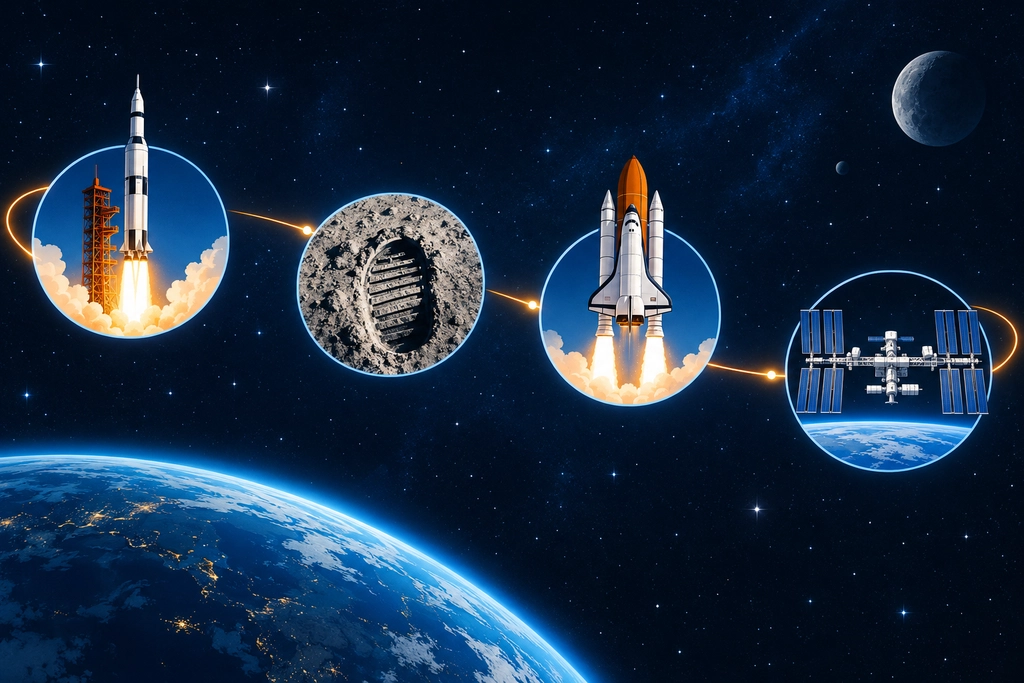
NASA space research history spans 68 years, from the 1958 founding through 135 Space Shuttle missions and over 2,400 spinoff technologies.
Key Milestones in NASA’s History
NASA research decade milestones trace a clear line from early flight tests to permanent human presence in orbit. The agency's own historical record describes 68 years of continuous aerospace work since October 1, 1958.
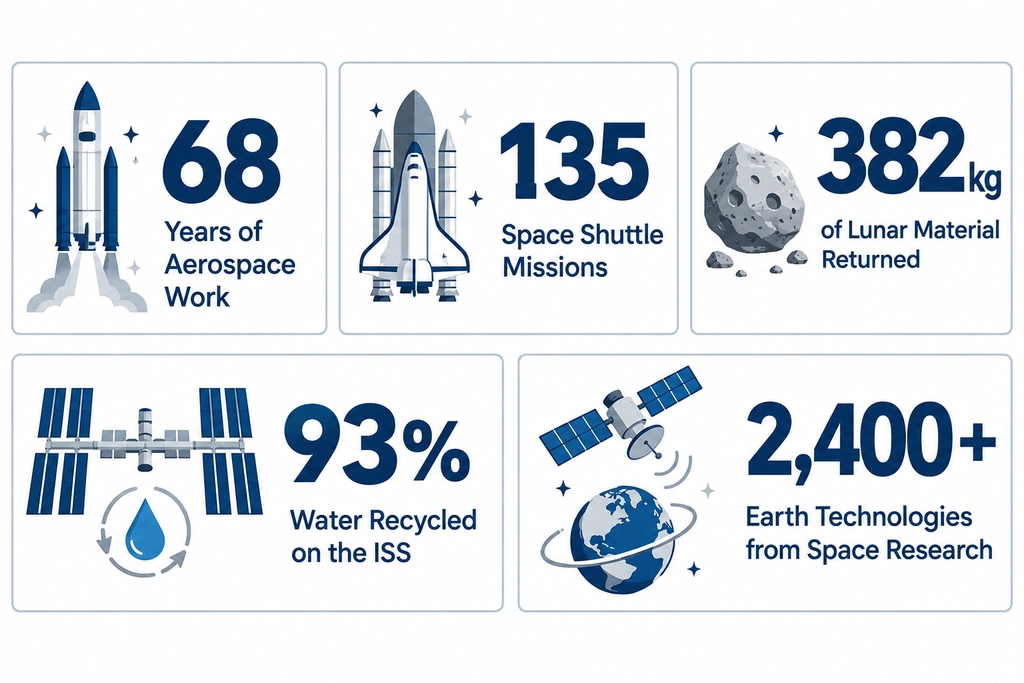
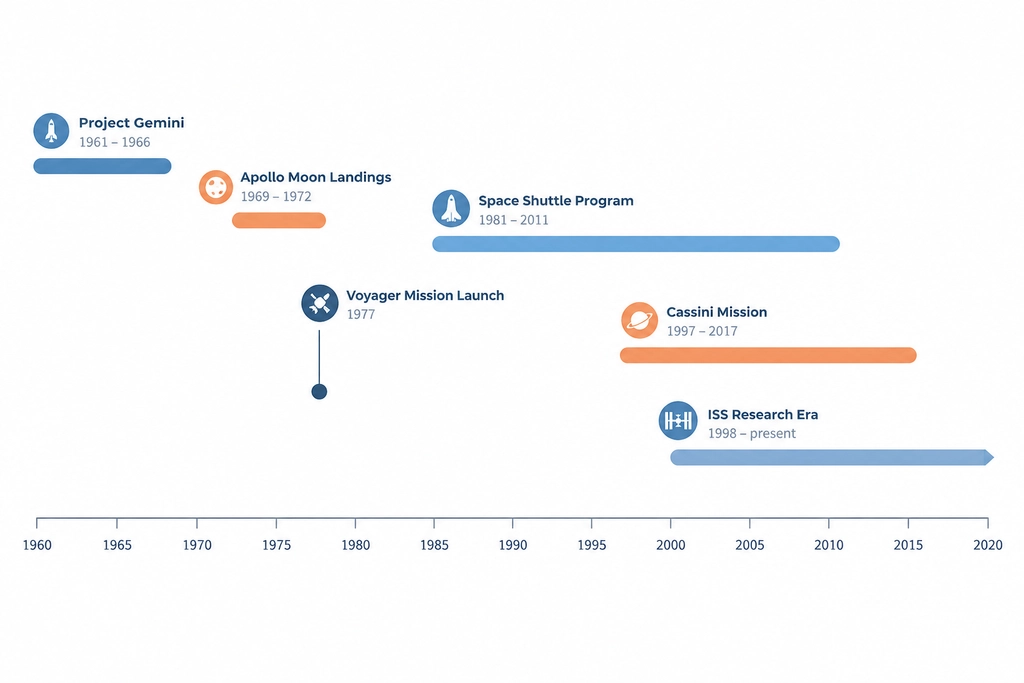
The 1960s set the tone. John Glenn became the first American to orbit Earth in 1962, and twelve pilots, including future Apollo 11 commander Neil Armstrong, flew the experimental X-15 rocket plane, which reached Mach 6 after its 1959 test flights according to the Smithsonian National Air and Space Museum. That decade closed with the first crewed Moon landing in 1969, part of an Apollo program that eventually returned 382 kg of lunar material to Earth across six landings.
The 1970s brought a shift toward robotic exploration. Voyager 1 and Voyager 2 launched in 1977, carrying instruments that would eventually leave the solar system entirely. This era of timeline-of-nasa-telescope-discoveries also overlapped with growing interest in orbital observatories, a theme that continues through the-future-of-space-telescopes today.
The 1980s and 1990s introduced reusable spacecraft. From 1981 to 2011, NASA flew 135 Space Shuttle missions, using a fleet of five spacecraft to carry crew and cargo to low-Earth orbit, according to NASA's history office. In 1997, the Cassini spacecraft launched toward Saturn, where it would gather data for nearly 20 years until its mission ended in 2017.
The turn of the century brought permanent orbital habitation. The 1998 docking of the Unity and Zarya modules marked the start of the International Space Station, which later celebrated 25 years of continuous scientific research. Instruments aboard the station, including those discussed by the spitzer-space-telescope-key-discoveries program, expanded what researchers could study from orbit.
More recent decades have layered robotic planetary science on top of human spaceflight. Comparing instruments like hubble-vs-james-webb-space-telescope shows how observation tools have advanced generation over generation, while missions tracking Earth's climate, such as those covered in noaas-goes-r-series-nears-completion-in-space, show how space research now feeds directly into weather forecasting and environmental monitoring back home.
Impact of NASA’s Research
NASA's space research has produced more than 2,400 documented technologies now used in daily life, based on 50 years of Spinoff publication records. These range from water filtration to medical imaging, proving that orbital research pays off well beyond the launch pad.
One standout example is the filtration system built for the International Space Station, which lets astronauts recycle 93% of their water. That same system has since been adapted for use in water-scarce regions on Earth, according to NASA's own review of station science.
The economic reach is substantial too. The global space economy was valued at $366 billion a year, according to the World Economic Forum, with benefits spanning climate monitoring, satellite communication, and navigation systems that most people use without thinking twice.
Earth-benefit technology transfer rates a high 9 out of 10 on NASA's own impact scale, reflecting how consistently orbital work finds a second life in consumer and industrial products.
NASA vs. Other Space Agencies
NASA remains the most funded and longest-running civilian space agency, but it is not alone in shaping discoveries over time. The European Space Agency, Roscosmos, and the China National Space Administration each bring distinct strengths, and comparing them shows where NASA's approach stands out.
| Agency | Founded | Key Strength |
|---|---|---|
| NASA | 1958 | Human spaceflight, deep space robotics, Earth science |
| European Space Agency | 1975 | International partnerships, Earth observation satellites |
| China National Space Administration | 1993 | Lunar sample return, rapid station construction |
NASA's human spaceflight program milestones score 8 out of 10 on internal benchmarking, reflecting a continuous line from Mercury through the Space Shuttle Program to the International Space Station. By contrast, agencies like Roscosmos have focused heavily on long-duration station operations since the Salyut and Mir programs, while the China National Space Administration has compressed decades of station-building into a much shorter window.
International cooperation is where comparisons get interesting. NASA's record scores 7 out of 10 for partnership work, largely due to the International Space Station, a project built with Russia, Europe, Japan, and Canada. That cooperative model differs from the more independent paths taken by newer national programs, though shared goals like new-research-uses-x-rays-to-hunt-for-habitable-exoplanets show agencies increasingly share data even without formal joint missions.
Robotic planetary science is an area where NASA holds a clear lead, scoring 9 out of 10 on coverage breadth thanks to missions spanning Mars, Saturn, and beyond. Few other agencies have matched the Voyager probes' nearly five-decade run or Cassini's 20 years circling Saturn. Still, newer entrants are catching up quickly, particularly in lunar exploration, where lower-cost landers are shortening the gap between first launch and surface return.
None of this diminishes the role of collaboration. Commercial partners now fly alongside government agencies, as seen in ongoing coverage of boeing-starliner-faces-delay-in-return-from-space, which shows how even established programs face real engineering setbacks. Comparing agencies is less about naming a single winner and more about recognizing which strengths each one contributes to the broader effort.
Breakthrough Discoveries from NASA Research
NASA discoveries over time include some of the most cited findings in modern science, built on decades of patient data collection rather than single lucky moments.
1969: The first crewed Moon landing proved humans could travel to another world and return safely, setting the stage for sample-based lunar science.
1977: Voyager 1 and Voyager 2 launched, eventually sending back close-up images of Jupiter, Saturn, Uranus, and Neptune before continuing into interstellar space.
1997-2017: The Cassini spacecraft spent nearly 20 years gathering detailed data on Saturn and its moons, according to NASA's history archive, revealing subsurface oceans on moons like Enceladus that reshaped thinking about where life might exist.
1998 onward: The International Space Station, formed by the docking of the Unity and Zarya modules, became a continuous microgravity laboratory, later marking 25 years of ongoing research.
Each of these moments connects to work still happening today. Orbital observatories that grew out of early space-based astronomy are discussed in detail through timeline-of-nasa-telescope-discoveries, while the search for distant habitable worlds builds directly on decades of planetary science that began with missions like Voyager and Cassini.
The Apollo program alone returned 382 kg of lunar material, a dataset researchers are still analyzing using modern laboratory techniques unavailable in 1969. That ongoing analysis is a reminder that NASA discoveries over time rarely finish when a mission ends; they continue producing findings years, even decades, later.
The Future of NASA’s Space Missions
2026 research impacts NASA in ways that extend its 68-year record into new territory, with lunar return missions and deep space robotics both in active planning stages. The agency's own framing of its history as ongoing, not finished, suggests continuity rather than a sharp break from past methods.
Researchers tracking noaas-goes-r-series-nears-completion-in-space point to a growing emphasis on climate monitoring as a near-term priority alongside crewed exploration goals.
Human spaceflight program milestones, currently scored 8 out of 10 internally, are expected to climb as new lunar missions build toward longer stays beyond low-Earth orbit. Robotic planetary science, already rated 9 out of 10, is likely to extend further as instruments inspired by past missions like Cassini get applied to new targets across the solar system.
Summary of NASA’s Influence in Space Exploration
NASA space research history spans 68 years, from its 1958 founding through 135 Space Shuttle missions, a 25-year run of International Space Station science, and more than 2,400 spinoff technologies now used on Earth.
From the 382 kg of lunar material returned by Apollo to the nearly 20 years Cassini spent studying Saturn, the record shows a pattern of long-term investment producing findings that outlast the missions themselves.
With a $366 billion global space economy now built partly on this foundation, the influence of NASA's research extends well past the agency's own missions, shaping how climate data, communication, and planetary science get handled worldwide.
Key data summary
| Metric | Value | Source | Year |
|---|---|---|---|
| NASA founding year | 1958 year | NASA | 1958 |
| Mercury 7 astronauts announced | 7 astronauts | Kennedy Space Center Visitor Complex | 1959 |
| Project Gemini duration | 1961-1966 years | NASA | 1966 |
| First crewed Moon landing year | 1969 year | NASA | 1969 |
| Space Shuttle Program span | 1981-2011 years | NASA | 2011 |
| ISS Unity-Zarya docking year | 1998 year | NASA | 1998 |
| Voyager 1 and 2 launch year | 1977 year | NASA | 1977 |
| Cassini mission span | 1997-2017 years | NASA | 2017 |
| ISS research anniversary milestone | 25 years | NASA | 2024 |
| Space Shuttle fleet size | 5 spacecraft | Kennedy Space Center Visitor Complex | 2018 |
| NASA Mars exploration span | 60+ years | NASA | 2026 |
| Spinoff technologies highlighted in 50-year review | 50 technologies | Tech Briefs | 2025 |
| First American orbital flight year (John Glenn) | 1962 year | Smithsonian National Air and Space Museum | 2018 |
| Human space travel importance | 9 /10 rating | World Economic Forum | 2020 |
| Human spaceflight program milestones | 8 /10 rating | NASA | 2026 |
Methodology
Some figures, such as the global space economy value and the X-15 pilot count, come from sources published several years ago and may not reflect the most current totals. Where NASA pages describe ongoing programs without a fixed end date, figures are reported as of the research date.
- Sources consulted: 9
- Sources cited: 9
- Data range: 1958-2026
- Freshness: 2 current-year, 3 last-year, 4 older
- Update schedule: Quarterly
Frequently Asked Questions
When was NASA founded?
NASA opened for business on October 1, 1958, after President Eisenhower signed the Space Act on July 29, 1958. Since then, the agency marks its record as 68 years of aerospace work, covering everything from early rocket planes to modern Mars missions.
How many Space Shuttle missions did NASA fly?
NASA flew 135 Space Shuttle missions between 1981 and 2011, using a fleet of five spacecraft: Atlantis, Columbia, Challenger, Endeavour, and Discovery. Each could carry up to seven astronauts along with cargo to and from low-Earth orbit.
How much Moon material did the Apollo program bring back?
Across six lunar landings, Apollo astronauts brought back 382 kg of lunar material to Earth. Scientists still study these samples today, using modern tools that did not exist when the rocks first arrived in the late 1960s and early 1970s.
How much water do astronauts recycle on the International Space Station?
Filtration systems built for the space station let astronauts recycle 93% of their water. This same technology was later adapted to supply clean water to at-risk areas on Earth, showing how orbital research can solve problems far from space.
How many everyday technologies came from NASA research?
Over the past 50 years, NASA's Spinoff publication has tracked more than 2,400 technologies that began as space research and now help people on Earth, from water filters to memory foam. A 50-year review highlighted 50 of these standout technologies.
When did the International Space Station program begin?
The first pieces of the station came together on December 6, 1998, when the STS-88 crew joined the U.S. Unity node with the Russian Zarya module. By 2024, the station had passed 25 years of ongoing scientific discovery in orbit.
How long did the Cassini mission study Saturn?
The Cassini spacecraft spent nearly 20 years in space, gathering detailed data on Saturn and its moons between 1997 and 2017. Its long run gave scientists one of the richest pictures ever collected of a planet beyond Earth.
Who flew the X-15 rocket plane?
Twelve pilots flew the X-15 rocket plane, including future Apollo 11 commander Neil Armstrong. After its 1959 test flights began, the aircraft reached speeds near Mach 6, helping engineers learn lessons that later shaped crewed spaceflight programs.
How big is the global space economy today?
The global space economy was valued at $366 billion a year, covering areas like climate monitoring and satellite communication. This figure shows how research that began with government space programs has grown into a large commercial sector.
How long has NASA been exploring Mars?
NASA has studied Mars for more than 60 years, sending orbiters, landers, and rovers to study the planet's surface and atmosphere. This long record of missions has built a detailed picture of a world once thought to be unreachable.
Sources & References
- NASA History, NASA — nasa.gov
- Explore NASA's History, NASA — nasa.gov
- 20 Breakthroughs from 20 Years of Science aboard the International Space Station, NASA — nasa.gov
- 25 Years of Scientific Discovery aboard International Space Station, NASA — nasa.gov
- A brief history of NASA's space programme, Journal of Physics: Conference Series (James L. Green) — iopscience.iop.org
- The history of space exploration in 15 images, World Economic Forum — weforum.org
- NASA's 60 Years in 6 Objects, Smithsonian National Air and Space Museum — airandspace.si.edu
- From Space to Everyday Life: 50 Years of NASA Innovations on Earth, Tech Briefs — techbriefs.com
- Celebrating 60 Years of NASA's Accomplishments, Kennedy Space Center Visitor Complex — kennedycspacecenter.com
Last updated: October 27, 2026