 0
 0
Key Findings at a Glance
- → 308 million barrels Bipartisan Policy Center reports current SPR crude oil holdings at 308 million barrels, less than half of the 714-million-barrel total capacity and the lowest level since 1983. [Bipartisan Policy Center]
- → 284.6 million barrels The SPR held 284.6 million barrels in the week ending September 18, 2026, its lowest level since November 1982, when the reserve was first being filled. [Atlantic Council]
- → 172 million barrels The United States committed 172 million barrels to a 400-million-barrel joint release coordinated by 32 IEA member nations after Strait of Hormuz tanker traffic was shut down on February 28, 2026. [Atlantic Council]
- → 411 million barrels At the end of calendar year 2025, the SPR crude oil inventory stood at 411 million barrels, equal to about 125 days of U.S. crude oil net imports. [U.S. Department of Energy]
- → 283 million barrels Reuters reported the SPR held just 283 million barrels at the end of September 2026, the lowest level since October 1982. [Yahoo Finance]
- → 97.1 days Germany's emergency oil stock equaled 97.1 days of cover in August 2026, the largest IEA contribution among EU nations at 19.5 million barrels pledged. [Global Oil Shock]
- → ~250 million barrels Texas A&M petroleum engineering professor Siddharth Misra says roughly 250 million barrels is a practical minimum for maintaining safer high-rate SPR withdrawal operations. [Sherafy]
The U.S. Strategic Petroleum Reserve exists for one reason: to soften the blow when oil supply suddenly breaks, and 2026 has tested that purpose harder than any year since the early 1980s. What follows lays out exactly where the reserve stands today, why it dropped so fast, and whether what remains can handle another shock.
1How Full Is the Strategic Petroleum Reserve Right Now?
The SPR is authorized to hold 714 million barrels but currently holds only 39.5 percent of that capacity, according to Dave Manuel's 2026 tracking data. At today's prices, those remaining barrels carry a market value of about 28.8 billion USD.
A reserve built to hold 714 million barrels now sits at less than 40 percent of that figure. That gap matters because the SPR was designed with the 1970s oil embargoes in mind, when planners assumed the full 714-million-barrel figure would stay close to its authorized ceiling during emergencies. The 28.8 billion USD valuation, per Dave Manuel's 2026 figures, shows what's left, but it says nothing about how fast that oil could actually reach refineries if another supply shock hit tomorrow.
2The Government Has Spent 25.7 Billion Dollars Building This Reserve
The Department of Energy reports a total SPR investment of 25.7 billion USD, with an average purchase price of 29.70 USD per barrel across the program's history. Current market value of remaining stock, near 28.8 billion USD, now exceeds that original cost.
Oil bought decades ago at an average of 29.70 USD per barrel is now worth far more on paper than what the government originally paid for it. The Department of Energy's 25.7 billion USD total investment figure predates most of the price spikes seen since, including the jump from 61 USD to 118 USD per barrel in Brent crude during the first quarter of 2026 alone.
3How Fast Can the Reserve Actually Deliver Oil?
The SPR can reach a maximum nominal drawdown of 4.4 million barrels per day, with oil arriving at market within about 13 days of a release order, per Department of Energy figures. A 2026 exchange release required an 18 to 22 percent premium, per Yahoo Finance.
| METRIC | VALUE | SOURCE |
|---|---|---|
| Exchange premium required on 2026 SPR release | 18 to 22 percent | Yahoo Finance |
| U.S. days of oil cover at 2026 consumption levels | 14 days | Wikipedia |
| Source: Yahoo Finance | ||
Speed is the SPR's whole selling point, and the Department of Energy's numbers back that up: 4.4 million barrels per day of maximum drawdown, with oil reaching market in 13 days. But the mechanics of a 2026 exchange release tell a less flattering story. Yahoo Finance reported that refiners had to pay an 18 to 22 percent premium to access that oil, a cost that did not exist in earlier, better-stocked years. Put plainly, a leaner reserve still moves fast, but it moves at a steeper price. At 14 days of national oil cover under 2026 consumption levels, per Wikipedia's tally, the margin for error has narrowed considerably compared to when the reserve held closer to its full 714-million-barrel capacity.
4Four Gulf Coast Sites Hold Every Barrel in the SPR
Bryan Mound holds the most oil at 138.0 million barrels, followed by Big Hill with 89.1 million, Bayou Choctaw with 31.4 million, and West Hackberry with 23.7 million barrels, according to Dave Manuel's 2026 site-level data.
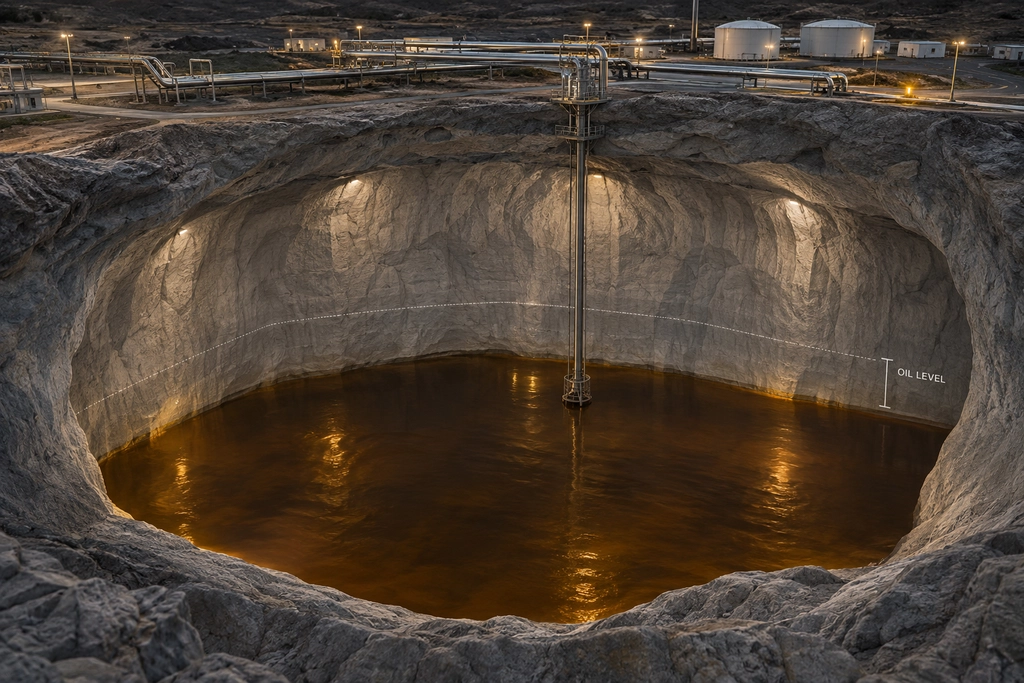
Bryan Mound alone holds nearly half of all remaining SPR crude, at 138.0 million barrels. Big Hill comes second with 89.1 million, while Bayou Choctaw and West Hackberry trail at 31.4 million and 23.7 million barrels respectively. These four underground salt cavern sites, all along the Gulf Coast, mean any hurricane or regional disruption near Texas or Louisiana carries outsized risk for the entire national reserve, since there is no comparable storage elsewhere in the country.
5The SPR Has Fallen From 726.6 Million Barrels to Near-Record Lows
SPR inventory fell from 415 million barrels in late February 2026, before the Hormuz closure, to 282.2 million barrels by October 30, 2026. The reserve's all-time high was 726.6 million barrels back in 2009, per Dave Manuel.
| METRIC | VALUE | SOURCE |
|---|---|---|
| 2022 SPR release under Biden administration | 180 million barrels | Bipartisan Policy Center |
| SPR inventory year-end 2023 | 354.7 million barrels | Yahoo Finance |
| SPR inventory year-end 2025 | 413.5 million barrels | Yahoo Finance |
| SPR inventory before Hormuz closure (late Feb 2026) | 415 million barrels | Yahoo Finance |
| SPR inventory week ending June 15-16 2026 | 340 million barrels | EnergyNow |
| SPR inventory week ending September 4 2026 | 285.4 million barrels | Wikipedia |
| SPR inventory week ending October 30 2026 | 282.2 million barrels | Dave Manuel |
| SPR record-high inventory (2009) | 726.6 million barrels | Dave Manuel |
| Source: Bipartisan Policy Center | ||
The numbers tell a steep story. At year-end 2023 the reserve held 354.7 million barrels. It climbed to 413.5 million barrels by year-end 2025, then to 415 million just before the Strait of Hormuz closure on February 28, 2026. From there it fell fast: 340 million barrels by mid-June, 285.4 million by September 4, and 282.2 million by October 30, according to EnergyNow and Wikipedia figures. That is a drop of roughly 133 million barrels in eight months. Compare that to the 2009 peak of 726.6 million barrels, and the current reserve looks like a fraction of what the program once held. The 2022 release under the Biden administration, at 180 million barrels, was large at the time but smaller than the ten-month 2026 decline.
6Crude Prices Nearly Doubled During the Same Window the Reserve Shrank
Brent crude opened 2026 at 61 USD per barrel and closed the first quarter at 118 USD per barrel, according to the Atlantic Council, coinciding with the SPR's steepest drawdown of the year.
| METRIC | VALUE | SOURCE |
|---|---|---|
| Brent crude price at start of 2026 | 61 USD per barrel | Atlantic Council |
| Brent crude price close of Q1 2026 | 118 USD per barrel | Atlantic Council |
| Source: Atlantic Council | ||
Brent crude nearly doubled in three months, from 61 USD to 118 USD per barrel. That price spike lines up almost exactly with the Strait of Hormuz disruption and the 172-million-barrel U.S. commitment to the 32-nation IEA joint release. Higher prices and a shrinking reserve arrived together, which is precisely the scenario the SPR was built to cushion against, not ride out alongside everyone else.
What the 282.2 Million Barrel Level Means Going Forward
Three numbers define the current situation: 282.2 million barrels in the reserve as of October 30, 2026, a 714-million-barrel authorized capacity that is less than 40 percent full, and a practical operating floor near 250 million barrels, according to Texas A&M's Siddharth Misra. The gap between where the reserve sits now and that floor is thin, roughly 32 million barrels, which leaves little room before withdrawal operations become riskier.
The pattern across 2026 is consistent: rising Brent crude prices, a Strait of Hormuz disruption, a 172-million-barrel U.S. commitment to an international release, and a reserve that fell from 415 million to 282.2 million barrels in eight months. None of these events happened in isolation.
For readers tracking energy security, the practical move is to watch the weekly Department of Energy inventory reports alongside Brent crude pricing, since the two have moved together throughout 2026. Anyone following broader technology and infrastructure shifts shaping energy policy may also find relevant background in coverage of Transformative Agricultural Innovations In 2026, where supply chain resilience faces similar pressure points.
Methodology
Reported barrel counts vary slightly by reporting week and source because the SPR level changes daily with sales, swaps, and refills; figures from different outlets may reflect different snapshot dates within 2026.
- Sources consulted: 9
- Sources cited: 7
- Data range: October 2025 - November 2026
- Freshness: 6 current-year, 1 last-year, 0 older
- Update schedule: Quarterly
Frequently Asked Questions
How much oil is in the Strategic Petroleum Reserve right now?
As of the week ending October 30, 2026, the U.S. Strategic Petroleum Reserve held 282.2 million barrels, just 39.5% of its 714-million-barrel authorized capacity. Other recent counts put the figure between 283 and 308 million barrels, depending on the reporting week and agency, but all point to a four-decade low.
Why is the Strategic Petroleum Reserve so low in 2026?
Years of sales combined with a major emergency release drained supplies. After Strait of Hormuz tanker traffic stopped on February 28, 2026, the U.S. released 172 million barrels as part of a 400-million-barrel joint action with 32 IEA member nations, pushing stocks toward their lowest point since 1982.
When was the SPR last this low?
The reserve has not been this empty since the early 1980s, when the program was still being filled. Reuters data cited by Yahoo Finance shows the SPR held 283 million barrels at the end of September 2026, the lowest level since October 1982, matching similar figures reported by the Atlantic Council.
What is the total capacity of the SPR?
The reserve is authorized to hold 714 million barrels across underground salt cavern sites along the Gulf Coast. With current stocks near 282 million barrels, the reserve sits at roughly 39.5% of that authorized capacity, according to the Department of Energy and independent tracking data.
What is the lowest safe level for the SPR?
Petroleum engineering experts point to a practical floor near 250 million barrels. Texas A&M professor Siddharth Misra notes that dropping much below this amount makes high-rate withdrawal operations riskier, since lower cavern pressure and oil volume can reduce the pumping speed needed during an emergency release.
How much is the Strategic Petroleum Reserve worth today?
Based on a West Texas Intermediate spot price of $101.91 per barrel on October 14, 2026, the current SPR holdings are valued at about $28.8 billion. That compares with roughly $25.7 billion the government has spent building facilities and buying crude since the program began.
How fast can the SPR release oil during an emergency?
The reserve can send oil to market within about 13 days of a presidential decision, with a maximum nominal drawdown rate of 4.4 million barrels per day. These figures, confirmed by the Department of Energy, show why the SPR remains a fast-response tool despite its shrinking size.
How do other countries' oil reserves compare to the U.S.?
Germany held the largest emergency stock contribution among EU nations in the 2026 IEA release, pledging 19.5 million barrels and holding supplies equal to 97.1 days of cover in August 2026. That is notably higher, in relative terms, than the days-of-cover level implied by current U.S. SPR holdings.
How much did the SPR hold at the end of 2025?
The Department of Energy reports that SPR crude oil inventory stood at 411 million barrels at the close of calendar year 2025, equal to about 125 days of U.S. crude oil net imports. The drop to roughly 282 million barrels by late October 2026 reflects a sharp decline over just ten months.
Which SPR storage sites hold the most oil?
Bryan Mound in Texas is the largest site, holding about 138.0 million barrels out of a 247.1-million-barrel capacity as of October 16, 2026. Big Hill follows with 89.1 million barrels, then Bayou Choctaw with 31.4 million barrels, showing how storage is spread across four Gulf Coast salt caverns.
Sources & References
- Dave Manuel. "Strategic Petroleum Reserve Storage and History 2026" — davemanuel.com. Accessed 2026-11-10.
- Bipartisan Policy Center. "How the U.S. Strategic Petroleum Reserve Works" — bipartisanpolicy.org. Accessed 2026-11-10.
- Atlantic Council. "The risks of the strategic petroleum reserve's four-decade low" — atlanticcouncil.org. Accessed 2026-11-10.
- U.S. Department of Energy. "SPR Quick Facts" — energy.gov. Accessed 2026-11-10.
- Yahoo Finance. "How Low Can the Strategic Petroleum Reserve Actually Go?" — finance.yahoo.com. Accessed 2026-11-10.
- Global Oil Shock. "Strategic Oil Reserves by Country 2026: Days of Cover" — globaloilshock.com. Accessed 2026-11-10.
- Sherafy. "How Low Can the U.S. Strategic Petroleum Reserve Go?" — sherafy.com. Accessed 2026-11-10.
Last updated: November 10, 2026