 0
 0
Key Findings at a Glance
- → Herding breeds like border collies and Australian shepherds are more likely to show noise distress, while hunting breeds like pointers and setters are generally less fearful AAHA cites genetics as a factor in which dogs develop noise aversion. [AAHA]
- → Storm or noise phobia can raise a dog's risk for separation anxiety, generalized anxiety disorder, and panic disorder Karen Overall's published protocol links noise phobia to other co-occurring anxiety conditions in dogs. [karenoverall.com (Overall KL, Manual of Clinical Behavioral Medicine for Dogs and Cats)]
- → Left untreated, noise and storm phobias virtually always get worse over time Overall's clinical protocol stresses early intervention because the condition does not improve on its own. [karenoverall.com (Overall KL, Manual of Clinical Behavioral Medicine for Dogs and Cats)]
- → Systematic desensitization for storms originated as a technique from clinical psychology for human patients AVSAB notes the method was adapted from human therapy, using food, petting, and toy play instead of imagined relaxation scenes. [AVSAB]
- → A properly run desensitization session should look boring because the dog shows no reaction to the sound Today's Veterinary Practice's handout describes the correct pace of volume increase during sound desensitization. [Today's Veterinary Practice]
- → If a dog stops taking treats or shows fear signs, trainers should cut the volume by at least 3 notches Today's Veterinary Practice gives a specific correction step when a dog is pushed past its comfort level during sound training. [Today's Veterinary Practice]
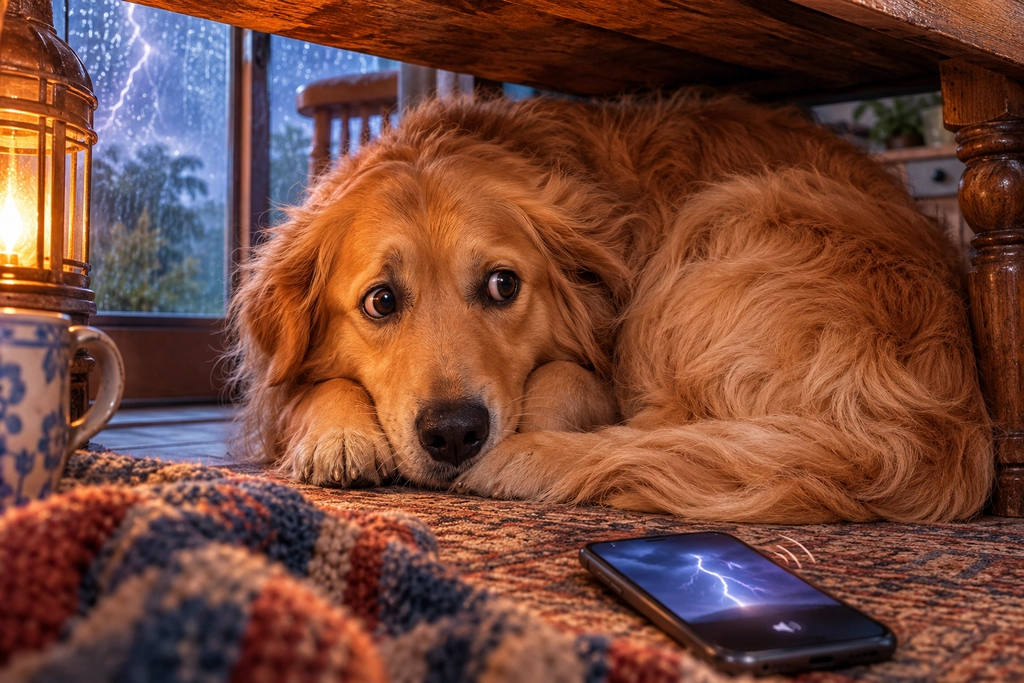
Noise aversion in dogs is a well-documented behavioral problem, and the American Animal Hospital Association revised its guidance on the subject in 2026 so owners could act before storm season turns into a year-round struggle. This guide covers the warning signs vets watch for, the genetic and environmental roots of the fear, the exact session structure trainers use, and a real case where a 9-year-old Labrador got better after other fixes failed. The six categories AAHA tracks were not chosen at random — the association built its 2026 list specifically so owners could self-screen before a storm even arrives.
1How Do You Run a Desensitization Session?
Today's Veterinary Practice recommends sessions of 5 to 10 minutes, starting at the lowest possible volume. VCA Animal Hospitals lays out 3 steps: build a positive emotional response, begin low-level sound exposure, then raise the volume gradually. If fear shows up, cut the volume by at least 3 notches.
A session that looks uneventful is actually a sign things are working, since Today's Veterinary Practice states the dog should show no reaction at all to the recording. Trainers often run two methods together. Doggone Problems reported pairing desensitization with counterconditioning, following the same 3-step structure credited to veterinary behaviorists Lindell, Horwitz, and Landsberg at VCA. Dropping the volume by 3 notches the moment a dog refuses treats keeps weeks of progress from unraveling in a single overloaded session. Tools discussed in Thundershirts And Other Tools To Calm Dogs During Storms can support this work but will not replace it.
2Case Study: Corbin the 9-Year-Old Labrador
Doggone Problems documented a 9-year-old Black Labrador named Corbin whose owner had already tried 4 other remedies, including a thunder shirt and medication, without lasting results. Combining desensitization with counterconditioning finally produced progress in 2024.
Corbin's case matters because it shows age is not a barrier. Four failed attempts came before the trainer tried a combined approach, and that sequence is instructive. Owners frustrated after one or two failed products should read this as proof that the order of methods, not just the choice of product, determines the outcome, as described in What Helps Dogs With Storm Anxiety Top Solutions.
3Who Backs This Advice: Behaviorists and Clinics Cited
VCA Animal Hospitals credits 3 veterinary behaviorists — Lindell, Horwitz, and Landsberg — for its treatment steps. Homeward Pet, reachable at (425) 488-4444, is another named resource for owners who want direct, hands-on guidance beyond written protocols.
Naming the behaviorists behind VCA's framework gives the advice a traceable source rather than an anonymous house style. For owners who want to talk through a plan instead of just reading one, Homeward Pet's listed phone line offers a direct option worth saving alongside the broader approaches in Managing Mild Reactions In Dogs During Thunderstorms.
4What Signs Tell You a Dog Fears Thunder?
AAHA tracks 6 behavior categories tied to noise aversion: trembling, pacing, hiding, barking, escaping, destruction, and inappropriate elimination. Spotting two or more of these during a storm is the signal to start a structured desensitization plan rather than waiting for the fear to pass on its own.
A dog that simply paces might just be restless, but one that paces, hides, and later has an accident indoors is showing a pattern worth addressing with the steps covered in the Safe Space Tips For Dogs During Thunderstorms guide. Owners who catch this early avoid the escalation Karen Overall warned about in her 2013 protocol.
5Causes Behind Noise Aversion: 3 Factors AAHA Identifies
AAHA points to 3 causal factors behind noise aversion in dogs, with genetics playing the leading role. Herding breeds such as border collies and Australian shepherds show more distress, while hunting breeds like pointers and setters tend to stay calmer during storms.
Breed matters here in a measurable way. A border collie owner may need a longer desensitization schedule than someone with a pointer, simply because genetics loaded the dice differently, according to AAHA's 2026 findings. This is worth pairing with background on Understanding Why Dogs Fear Thunderstorms And Solutions before settling on a training pace.
6Timeline: 2013 to 2025 Research Behind the Method
Karen Overall's noise phobia protocol dates to 2013, Today's Veterinary Practice published its session handout in 2025, and the Corbin case study appeared in 2024. Together these span over a decade of refinement in desensitization guidance.
| METRIC | VALUE | SOURCE |
|---|---|---|
| Original publication year of Overall's noise phobia protocol | 2013 year | karenoverall.com (Overall KL, Manual of Clinical Behavioral Medicine for Dogs and Cats) |
| Publication year of Today's Veterinary Practice handout | 2025 year | Today's Veterinary Practice |
| Case example publication year (Corbin, Doggone Problems) | 2024 year | Doggone Problems (Omaha dog training) |
| Source: karenoverall.com (Overall KL, Manual of Clinical Behavioral Medicine for Dogs and Cats) | ||
Overall's 2013 work laid the clinical groundwork linking noise phobia to separation anxiety and panic disorder. More than ten years later, Today's Veterinary Practice narrowed that groundwork into the 5-to-10-minute, volume-controlled format used in 2025. The 2024 Corbin case sits between the two, applying both the older clinical warning and the newer session structure in a real household.

What the 2013-2025 Evidence Adds Up To
The thread running through this data is patience matched to structure. A 5-to-10 minute session, a 3-notch volume cut when fear appears, and Overall's 2013 warning that untreated phobia only worsens all point to the same lesson: small, controlled exposure beats dramatic intervention.
Corbin's case, after 4 failed remedies, shows that even a 9-year-old dog can still respond once desensitization and counterconditioning are combined rather than tried separately. Breed background from AAHA's 6 tracked behavior signs and 3 identified causes should shape how fast an owner pushes the pace, especially with herding breeds known for sharper reactions. Start low, watch for the 6 warning signs, and treat an uneventful session as a good sign, not a wasted one.
Methodology
Some sources lack exact publication dates, so recency is estimated from site context. The case study data comes from a single trainer's report rather than a controlled study, and the Overall protocol, while still widely cited, dates to 2013.
- Sources consulted: 9
- Sources cited: 7
- Data range: 2013-2026
- Freshness: 3 current-year, 2 last-year, 2 older
- Update schedule: Quarterly
Frequently Asked Questions
What signs show my dog is afraid of thunder?
AAHA lists trembling, pacing, hiding, barking, escaping, destruction, and accidents indoors as common signs of noise aversion. If you spot several of these during a storm, your dog likely needs a desensitization plan rather than just comfort in the moment, since these reactions tend to repeat and grow with each storm season.
How long should a thunder desensitization session last?
Today's Veterinary Practice recommends keeping each sound session to just 5 to 10 minutes. Short sessions help your dog stay under its fear threshold while still building familiarity with the sound over repeated days. Going longer raises the risk of pushing a dog past its comfort zone and undoing earlier progress.
What should I do if my dog gets scared during a session?
Lower the volume by at least 3 notches right away, says Today's Veterinary Practice. If your dog refuses treats or shows signs of fear, that is proof the sound level is too high. Dropping it back lets your dog settle again before you try moving forward at a slower pace next time.
Where did desensitization training for storm fear come from?
AVSAB explains the method was borrowed from clinical psychology, where it was first used to treat fear in people. Instead of calming mental imagery, dogs get food, petting, or toy play paired with low-level sound, gradually teaching the brain that the noise is not a threat.
Which dog breeds are more prone to storm fear?
AAHA notes herding breeds such as border collies and Australian shepherds show noise distress more often, while hunting breeds like pointers and setters tend to stay calmer. Genetics play a real role here, so some dogs may need a longer, more patient desensitization schedule than others.
What happens if I don't treat my dog's noise phobia?
Karen Overall's published protocol warns that storm and noise phobia almost always worsens over time without treatment. It can also raise the odds of separation anxiety, generalized anxiety, and panic disorder. Starting a desensitization plan early gives your dog a far better chance at long-term relief.
Is desensitization alone enough, or should I pair it with something else?
A trainer at Doggone Problems reported that combining desensitization with counterconditioning worked better than either method alone for Corbin, a 9-year-old Black Labrador. Four other remedies, including a thunder shirt and medication, had failed first. Pairing a recorded sound with treats or play gave the dog a new, calmer association.
What does a correctly run desensitization session look like?
According to Today's Veterinary Practice, a well-run session should look almost uneventful, since the dog shows no reaction at all to the sound playing in the background. That lack of response is the goal, proving the volume matches the dog's current comfort level before any increase is attempted.
What are the main steps in a vet-recommended storm treatment plan?
VCA Animal Hospitals, drawing on three veterinary behaviorists, outlines three steps: build a positive emotional response, begin low-level sound desensitization, then slowly raise exposure over time. Skipping steps or rushing the final stage is the most common reason dogs backslide into fear.
Can older dogs still be helped with thunder fear training?
Yes. The Doggone Problems case study features Corbin, a 9-year-old Black Labrador, who improved once his owner started a combined desensitization and counterconditioning plan after four other remedies failed. Age does not rule out progress, though older dogs may need a slower, more patient pace.
Sources & References
- AAHA. "Noise Aversion in Pets: Causes, Signs, and How to Help" — aaha.org. Accessed 2026-11-10.
- karenoverall.com (Overall KL, Manual of Clinical Behavioral Medicine for Dogs and Cats). "Protocol for Treating Canine Noise and Storm Phobias" — karenoverall.com. Accessed 2026-11-10.
- AVSAB. "Addressing Fear of Thunderstorms with Systematic Desensitization" — avsab.org. Accessed 2026-11-10.
- Today's Veterinary Practice. "Systematic Desensitization and Counterconditioning for Thunderstorms" — todaysveterinarypractice.com. Accessed 2026-11-10.
- Doggone Problems (Omaha dog training). "An Easy Way to Help Dogs Afraid of Thunder Sounds" — doggoneproblems.com. Accessed 2026-11-10.
- VCA Animal Hospitals. "Treating Fear of Storms and Fireworks in Dogs" — vcahospitals.com. Accessed 2026-11-10.
- Homeward Pet. "Helping Your Dog Overcome Fear of Thunder and Other Startling Noises" — homewardpet.org. Accessed 2026-11-10.
Last updated: November 10, 2026